Image Credit: Canva
Note from The Tennessee Conservative: Editorial statements in this column are the sole opinion of the author; they do not necessarily reflect the opinions of the staff of this publication.
Submitted by Peter Maher –
Tennessee’s public records law is supposed to be simple. When a Tennessean requests records related to official government business, our government should either provide the records, explain why they are exempt, or identify when they will be available.
That process should not be complicated.
Yet across our state, the simple act of requesting public records is increasingly being routed through private, third-party software platforms. Many of our state and local governments now rely on outside vendors to administer public records requests.

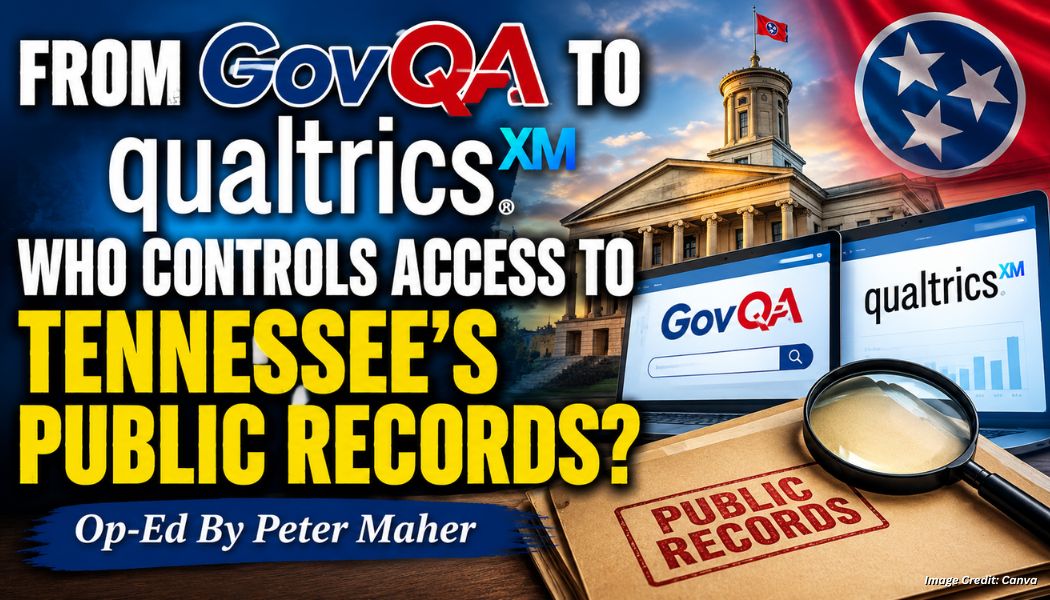
GovQA, now part of Granicus, administers public records portals for Memphis, Clarksville, Nashville, Chattanooga, Knox County, several and other public entities. Other Tennessee governments use a variety of third-party public records platforms. Hamilton County, Johnson City, Mt. Juliet, and Lebanon utilize the NextRequest platform for public records administration. The University of Tennessee, the City of Murfreesboro, and the City of Gallatin utilize the JustFOIA platform. The University of Memphis utilizes Qualtrics, a survey and data-collection platform.
The State of Tennessee is scattered but often appears to operate a statewide public records portal through ArkCase. Meanwhile, other Tennessee governments follow entirely different approaches. The City of Jackson, for example, appears to administer public records requests through a straightforward and locally managed system rather than a third-party records-request platform. As a result, Tennesseans may encounter a wide variety of technologies, procedures, and privacy practices depending upon which governmental entity possesses the records being sought.
As a result, Tennesseans seeking access to public records may encounter entirely different systems, privacy practices, account requirements, and user experiences depending upon which public institution happens to hold the record.
Although these systems are intended to facilitate access to public records, they have also created a patchwork of different procedures, different privacy practices, different account requirements, different data-collection practices, and different barriers depending entirely upon which Tennessee government receives a request.
As administration of our public records system becomes increasingly outsourced to private vendors, Tennesseans should expect transparency not only from our government agencies, but also regarding the systems our governments pay for and use to manage public access to government records.
That may sound like a minor administrative detail. It isn’t.
Public records access is one of the most important tools Tennesseans have to monitor our local and state governments. It is how we review contracts, emails, spending, lawsuits, police records, public debt, school board decisions, public meeting records, and the day-to-day actions of public officials. When our governments insert private software vendors into that process, we have every right to ask what information is being collected, who controls it, how long it is retained, and whether the platform creates unnecessary barriers to exercising a statutory right.
To be clear, software can be useful. A well-designed public records portal can help agencies track requests, preserve communications, manage deadlines, reduce lost emails, and organize responses.
But efficiency for government employees cannot become surveillance, confusion, or unnecessary burden for Tennesseans.
Many of these portals require Tennesseans to create accounts, provide personal information, verify email addresses, upload proof of Tennessee citizenship, select categories, monitor online dashboards, and retrieve records through third-party vendor-controlled systems. Some platforms maintain request histories, message histories, audit trails, user accounts, invoices, uploaded documents, and administrative logs.
That means the platform is doing more than simply transmitting a request. It is creating a digital record of a citizen’s public records activity.
That should concern Tennesseans.
Tennesseans request records about public finance, economic development, school board meetings, public contracts, land-use decisions, airport authorities, government debt, and political favoritism. Everyone needs public records laws to gather information and hold government accountable.
That raises obvious privacy questions. If a Tennessean uploads a driver’s license or other proof of Tennessee citizenship, where is that document stored? Is it retained by the government, the vendor, or both? Can agency employees access it later? Can vendor employees access it? Can staff forward it? Is it deleted after verification? Is it subject to a retention schedule? Could it be produced in response to another public records request?
These are not absurd questions. They are basic public administration questions.
The same is true of location metadata. Web-based portals can generate logs containing IP addresses, browser information, device information, timestamps, session activity, login history, and request activity. Tennesseans should know whether our governments are collecting that information through public records portals, whether vendors retain it, and whether government employees can access it.
The concern should be obvious. A Tennessean seeking transparency from our government may first have to upload a state-issued identification document into a private vendor’s system without any clear explanation of where that information is stored, who can access it, how long it is retained, or whether it is shared.
There is also a serious consistency problem.
GovQA administers public records portals for several major Tennessee municipalities. Yet the request process is not the same from one city to another.
Based on my own experience with these portals, after I raised concerns regarding the amount of information being required from requesters, the City of Memphis modified its GovQA public records request process and removed certain required fields. Other Tennessee governments using the same GovQA platform have not taken the same approach.
The City of Chattanooga is a cornering example. Although Chattanooga uses the same GovQA platform as Memphis, it declined to make similar changes and continues to require information that Memphis determined was unnecessary. As a result, Tennesseans using the same third-party vendor face different requirements.
That should concern all Tennesseans.
If Memphis can successfully operate the same platform while collecting less information from citizens, why can’t other Tennessee governments? If certain fields are not essential in Memphis, what public purpose is served by requiring them in Chattanooga?
Public access rights should not vary substantially from one Tennessee community to another simply because different governments configure the same software in different ways. Citizens should expect a reasonable degree of consistency, transparency, and respect for privacy when exercising their statutory right to request public records.
The same concern applies to contracts. The contracts between GovQA and Tennessee governments are not identical. Memphis, Clarksville, Knox County, Nashville, and Chattanooga appear to have negotiated their own arrangements governing costs, implementation, and administration.
These contracts are paid for with public funds and govern how Tennesseans interact with their government when exercising a statutory right. Taxpayers should be able to easily review the agreements, privacy provisions, data-retention rules, and customization choices that shape the public records request process.
That deserves public scrutiny.
Every Tennessee government using a third-party public records platform should publicly disclose its contract, statement of work, privacy terms, data-retention rules, and policies governing requester information. Tennesseans should not have to file public records requests merely to understand what happens when they file public records requests. Iy is easy. Just post on the website.
At minimum, every public records portal used by a Tennessee governmental entity should clearly disclose the following information in a prominent and easily accessible location:
- How long uploaded identification documents are stored;
- Whether IP addresses, browser information, device information, or other metadata are collected;
- Whether requester histories are searchable or accessible by government employees;
- Whether employees of the third-party vendor can access requester information, communications, or records;
- Whether requester information or identifcation is shared, transferred, or disclosed to third parties;
- A copy of the current contract, statement of work, data-sharing agreement, or other agreement between the governmental entity and the third-party vendor administering the public records platform; and
- How long requester accounts, communications, uploaded documents, metadata, audit logs, and related records are retained.
Government should also explain why each required field is necessary. If a field is not required by Tennessee law, it should not be mandatory.
This issue is especially important in Tennessee because only Tennessee citizens have an enforceable right to inspect and receive copies of our public records under the Tennessee Public Records Act. That relatively unique citizenship requirement allows Tennessee governments to demand proof of residency or citizenship. But the existence of that requirement does not give agencies unlimited authority to track, collect, store, share identification documents, or profile Tennesseans.
A government may verify eligibility without building a permanent digital file on each Tennessean.
There is also a broader constitutional issue at stake. Public records laws are supposed to reduce the power imbalance between citizens and government. Third-party platforms risk reversing that relationship if they require citizens to jump through unnecessary hoops, surrender personal information, or communicate only through controlled vendor portals.
A simple public records request should not feel like applying for a commercial building permit. Nor should Tennesseans be required to create countless usernames and passwords, navigate multiple vendor portals, upload personal information, or agree to lengthy terms-of-use agreements simply to exercise a right granted by Tennessee law.
Public records access should be straightforward, accessible, and citizen-centered. The process should facilitate transparency, not create additional administrative or privacy-related barriers between Tennesseans and our government.
The Tennessee General Assembly should be paying attention. Tennessee’s public records law was not designed for a world in which private software vendors administer large portions of the records-request process, store requester communications, manage request histories, and potentially retain metadata about citizens exercising statutory rights.
The law should be clarified to ensure that third-party public records platforms do not become barriers to public access.
The principle should be simple: no Tennessee citizen should have to provide more personal information than the law requires to request public records.
If our governments use private vendors to manage transparency, the use of those vendors must itself be transparent. The contracts should be posted. The privacy terms should be posted. The data-retention rules should be posted. The required fields should be justified. The alternatives to using the portal should be clearly posted, especially regarding requests for agency records located on the opposite side of our state.
Public records access is not a customer-service feature. It is one of the only practical ways through which Tennesseans exercise the values embodied in our First Amendment. An informed citizenry is essential to free speech, public debate, civic participation, and democratic accountability. Without meaningful access to our government records, those freedoms cannot be reasonably or meaningfully exercised.
Tennesseans should not have to wonder whether exercising their right to request public records means creating an online profile, surrendering unnecessary personal information, maintaining multiple vendor accounts, or navigating a maze of usernames, passwords, and terms-of-use agreements.
The systems created to facilitate accountability should not become barriers to accountability.
Our public records belong to the people of our state. Accessing them should remain simple, consistent, and respectful of the privacy of the citizens who own them.

Examples of Third-Party Public Records Request Platforms Used by Tennessee Government Entities:
GovQA (Granicus)
Granicus | The Citizen Experience Platform for Government
https://govqa.com
https://granicus.com
NextRequest (CivicPlus)
Public Records Request Software for Public Agencies
https://www.nextrequest.com
JustFOIA
Leading FOIA Request Management Software
https://www.justfoia.com
ArkCase
ArkCase Enterprise Case Management Platform
https://www.arkcase.com
Qualtrics
Data Collection, Survey, and Experience Management Platform
https://www.qualtrics.com


One Response
Compliments of worse’n useless, do little dimmercrap and RINO gubmint employees.