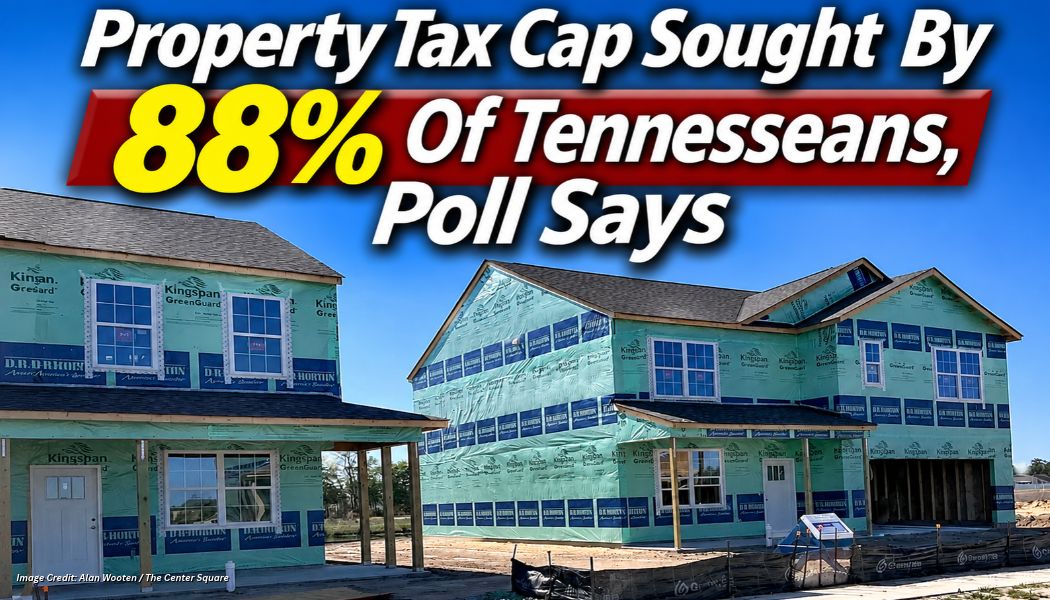
Image Credit: Alan Wooten / The Center Square.
By Kim Jarrett, The Center Square –
Tennesseans polled by the Beacon Center say they want to limit how much local entities can raise their property taxes.
More than 66% of Tennessee voters approved a constitutional amendment barring a statewide property tax, according to Nov. 3 election results published by the Secretary of State. Property taxes are enacted by counties, municipalities and school boards.

A Beacon Center analysis of data presented in an Aug. 12 Wall Street Journal article shows local property taxes have increased by 75%, the organization said. The Center Square has independently confirmed the Wall Street Journal information.
The Beacon Center, which supports property tax caps, conducted the poll between Oct. 24 and Nov. 3. It has a margin of error of +/- 2.77%. It asked 1,200 registered voters: “Should there be a limit on how much property taxes can increase each year in Tennessee with voter approval required for any increase above that limit?”
The analysis shows that it’s not just the state’s larger cities that have increased property taxes. In the small Chattanooga suburb of Red Bank, property taxes increased by 14% this year; in Mount Juliet, a Nashville suburb, property taxes were raised by 164%, according to the Beacon Center’s analysis.
Eighty-eight percent of the 1,200 polled said they back a property tax cap. Six percent opposed a property tax cap, and 6% were unsure.
“It was abundantly clear in our polling that people are struggling to make ends meet,” said Justin Owens, CEO of the Beacon Center. “And there’s not much state policymakers can do about things like tariffs, but there are things they can do when it comes to local property taxes that have gone up faster than any state in the nation.”
Half of those polled also said they don’t believe that their local cities or counties are spending property tax revenue wisely.
“We’ve seen tax increases followed by ‘we’re going to buy some pickleball courts’,” Owens said. “‘We’re going to open an aquatic center with Olympic-size swimming pools.’ And so I’m hard-pressed to believe that local governments are struggling to make ends meet when they’re spending things on frivolous items like that.”
Sen. Bo Watson, R-Hixson, introduced Senate Bill 2064 in January that could have curbed some increases. It would have barred local governments from enacting tax increases more than the rate of inflation plus 2%. If local entities want to raise taxes beyond the threshold, residents would have a chance to vote in a referendum. The bill never made it out of the Senate State and Local Government Committee in April.

Proponents and opponents have said it’s too soon to determine if the issue will come up again in the 2027 session of the General Assembly. The Tennessee Municipal League opposed the bill during the 2026 session, saying it would have an immediate and lasting negative impact. Capping property taxes would threaten municipalities’ ability to repay debt and fulfill contracts, according to the organization’s online legislative agenda for 2026.
The limit would hit small towns the hardest, the organization said.
“Many rural communities rely almost entirely on property taxes because they lack the retail, restaurants, and industry that generate other local revenues,” the organization said. “Capping this primary revenue source would stall progress, deter new investment, and make it even harder to attract residents or businesses – accelerating population loss and limiting future development.”
Corinne Gould of the Tennessee Municipal League said in a text message to The Center Square that it’s too early to comment on potential legislation for next year.
“New leaders in the governor’s office and General Assembly will likely affect legislative priorities,” Gould said.
Brooke Sheely, a member of Watson’s communication team, said the senator would like to “regroup with you” after the session begins in January when asked whether he would introduce the bill again.