Image Credit: Canva
Tennessee Conservative News [By Paula Gomes] –
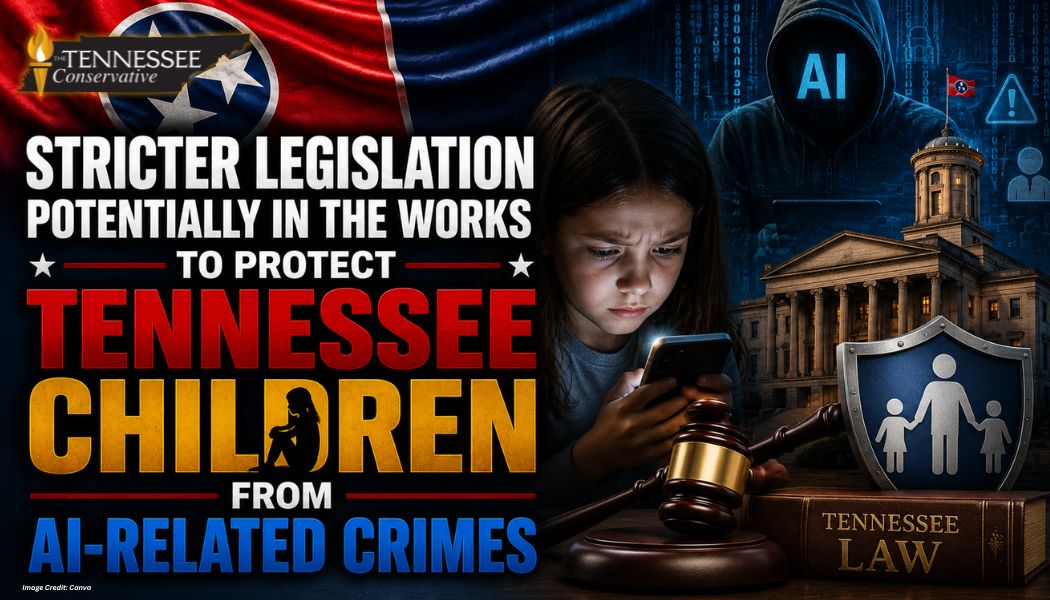
JC Bowman, CEO of Professional Educators of Tennessee, has spoken with state lawmakers about new legislation aimed at protecting children from AI-related crimes. The General Assembly is set to reconvene in January.
While Bowman acknowledges that AI can be a useful tool, he cautions that newer technology should not be assumed to be better than what has always been the bedrock of a good education. In particular, Bowman would like to see more focus on the basics in K-5 favoring books and teacher interaction over passive screen consumption.
Additionally, Bowman is calling on parents to be responsible when giving their children smartphones as the sharing of explicit images among minors – aka “sexting” – is a growing issue, one that can lead to youth entering the criminal justice system because of one impulsive choice.

While schools in Tennessee must report any suspected child sexual exploitation material (CSAM), and restrictions on student phone use during class have been enacted, parents mus still supervise their children’s use of their phones, the internet, and AI tools.
There has been an uptick in crimes against children related to artificial intelligence over the past few years.
Recently, an elementary school janitor was accused of making child sexual abuse material (CSAM) in Hamilton County.
A referral from the National Center for Missing and Exploited Children (NCMEC) led to Hamilton County detectives arresting 28-year-old Zackary Nelson who had been working at Daisy Elementary School.
The referral from NCMEC associated Nelson with an account containing an image of an adult female employed at the school, along with two male children. All appeared to be pantless as a result of the photo being digitally altered.
A search of Nelson’s home resulted in the seizure of numerous electronic devices. Investigators found nearly 4,000 digitally altered photos and videos of children and adults. Authorities state that more than 100 of the images had been manipulated to portray children engaging in explicit sexual acts in various stages of nudity.
A teacher employed by Metro Nashville Public Schools (MNPS) since 2004 was also recently fired after reports that he took photos of students and used AI to alter them and create videos without consent.
Mario Mumphery, a tenured exceptional education teacher at Nashville Big Picture High School was reported by Principal Brenda Diaz to both the Metro Nashville Police Department and to the Tennessee Department of Children’s Services (DCS) after speaking with multiple students who had concerns. An active DCS investigation is ongoing.
It is already illegal under state law to produce and possess nonconsensual AI-generated images, those found in violation of the law face civil and criminal penalties.
Earlier this year, lawmakers passed the “Tennessee Anti-Grooming Act” which went into effect on July 1st and covers both in-person and electronic interactions between students and teachers.
The offense of grooming carries a range of penalties from a Class A misdemeanor to a Class B felony depending on a variety of factors which include the severity of the offense, the position of trust or authority the offender had over a victim, and the ages of both offender and victim.
The Tennessee School Boards Association’s Teacher Discipline Guide outlines the reasons why teachers may be suspended or dismissed. Known as the “Big 5,” they are improper conduct, incompetence, inefficiency, insubordination, and neglect of duty.
Bowman says that only a very small percentage of educators turn out to be bad apples, but student safety overall is a moral obligation, and not a partisan issue.
Tennessee lawmakers have already passed some laws in regard to AI over the last few years.
The Ensuring Likeness Voice and Image Security Act or ELVIS Act, signed in 2024, was the nation’s first law to protect artists, musicians, and performers in Tennessee from being copied by AI without their consent.
Other bills that Tennessee lawmakers have passed include preventing AI from impersonating medical professionals, mandating social media and internet safety in schools, and some watered down legislation that was stripped of its enforcement penalty and instead requires that the Tennessee Artificial Intelligence Advisory Council study and understand the impact of AI on state government and the people of Tennessee.
The “Transparency for Deepfakes in Political Advertising Act” also went into effect last month and plaintiffs of a federal suit against AI companies are bringing their claims under the 2025 law which creates criminal penalties for creating, possessing, or distributing technology designed to create AI-generated sexual content of minors.

About the Author: Paula Gomes is a Tennessee resident and reporter for The Tennessee Conservative. You can reach Paula at paula@tennesseeconservativenews.com.

One Response
Good, thanx.