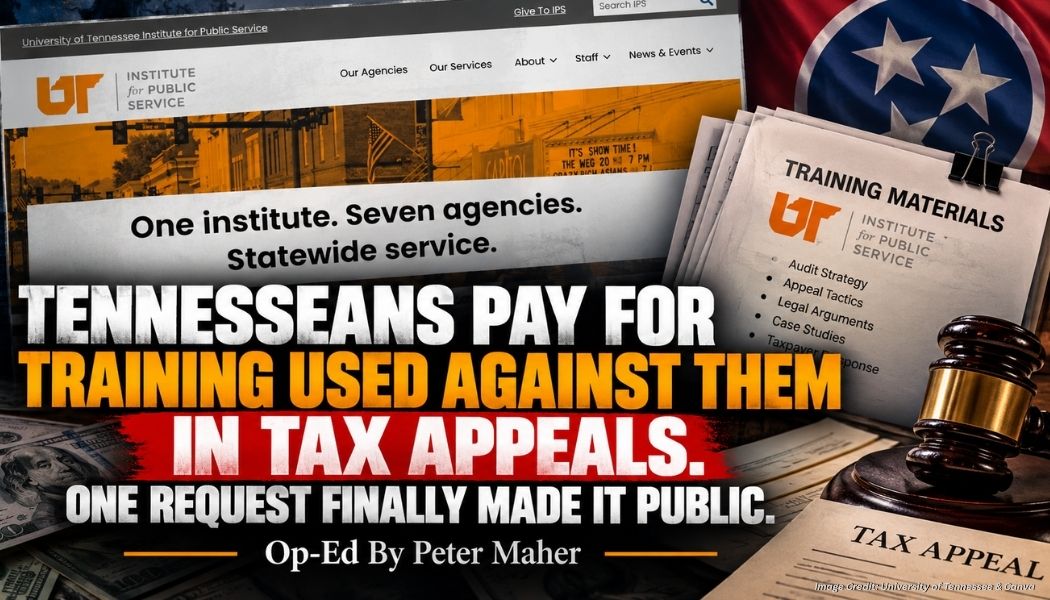
Image Credit: University of Tennessee & Canva.
Note from The Tennessee Conservative: Editorial statements in this column are the sole opinion of the author; they do not necessarily reflect the opinions of the staff of this publication.
Submitted by Peter Maher –
In mid‑September, something happened inside Tennessee’s public‑records system that had never happened before. A single email exchange between a Tennessean and the University of Tennessee System cracked open a wall that had always stood. For the first time, copyrighted CTAS tax‑appeal training videos — long treated as secret, off‑limits, and “for officials only” — were released to a taxpayer under the Tennessee Public Records Act (TPRA).
The request that forced this disclosure was filed on July 28, 2026, the same day CTAS began its tax‑appeal training in Nashville. CTAS, the County Technical Assistance Service, is a taxpayer‑funded division of UT’s Institute for Public Service (IPS). IPS is UT’s statewide public‑service arm, operating out of the Tennessee Municipal League building in downtown Nashville.
The training — Appeal Preparation and Testimony Skills for Tax Appeal Hearings — was delivered through UT’s K@TE online platform. CTAS never disclosed the street address of the training, but it was almost certainly held inside our downtown Nashville offices at 226 Anne Dallas Dudley Boulevard, where CTAS hosts most COCTP (County Officials Certificate Training Program) courses. Even after releasing the videos, UT still has yet to tell Tennesseans where their own taxpayer‑funded tax appeal training occurred.
This disclosure did not happen because Tennessee’s accountability system works. It happened because one Tennessean insisted on electronic access, cited the law repeatedly, and refused to accept the narrow, exclusionary inspection window UT attempted to impose.
UT Tried to Force In‑Person Viewing
From the start, the requester asked for electronic copies. The videos were created electronically, stored electronically, and used electronically by CTAS and UT employees.
UT responded by offering only in‑person viewing at one rural UT Extension office:
“Available September 14, 15 and 16.”
Three weekdays. Business hours only. One rural location. No electronic option.
This shut out Tennesseans with fixed work schedules, public‑service commitments, disabilities, caregiving responsibilities, long‑term‑care residency, lack of transportation, or long travel distances. Most Tennesseans cannot drop everything to travel to a rural office during business hours. Meanwhile, CTAS staff, county officials, and UT employees — the people who created and use the training — can watch the videos anytime.
The inspection window wasn’t just narrow. It was legally unreasonable.

UT Quietly Admitted the Videos Could Be Released Electronically
When pressed, UT could not identify any legal or technical barrier to electronic production. Then, on September 17, UT finally admitted:
“The individuals who created the videos… hold the copyright… and they have consented to provide the videos to the public.”
This revealed something legally extraordinary:
- The videos are copyrighted.
- The copyright holders are private individuals, not UT.
- UT maintains and distributes the videos anyway.
- UT admits they are public records.
- UT can provide electronic copies.
Private copyright ownership of official government‑training materials is highly unusual. It raises serious questions about who controls access, who sets restrictions, and whether UT has ever documented this arrangement. When the requester asked for clarification, UT went silent.

Why This Matters
CTAS trains county officials on how to handle property‑tax appeals — a process affecting every homeowner, business, and farmer in Tennessee. Each year, tens of thousands of Tennesseans file appeals involving hundreds of millions of dollars in assessed value. The fairness of these appeals determines whether families overpay, whether small businesses survive, and whether farmers can keep their land.
Yet until this disclosure:
- no attorney outside government had ever seen the training
- no journalist had ever reviewed it
- no taxpayer had ever accessed it
- no oversight body had ever evaluated it
The entire system operated in secrecy.
This release establishes a precedent: taxpayer‑funded training used in official government business is a public record — even when copyrighted.
UT’s Public‑Service Mission Makes This More Concerning
The University of Tennessee System is not a private institution. It is a statewide public university with statutory duties to serve Tennesseans. IPS — the division that houses CTAS — was created to provide public‑service support to local governments, a nationally unusual and concerning role for a public university that is supposed to serve the public directly.
When UT hides taxpayer‑funded training used in official government proceedings, it violates not only TPRA’s requirements but UT’s own public‑service commitments.
Tennesseans Pay for CTAS Training — But Cannot See It
CTAS training is funded by homeowners, business owners, farmers, and families across Tennessee. Yet for decades, Tennesseans have been blocked from seeing the training used to judge their own appeals.
Several years ago, I became the first non‑county official ever permitted to access UT’s CTAS county‑commissioner training — and it required persistent effort, initial denial, and direct engagement with CTAS attorneys. Even today, that same access is not openly offered to all Tennesseans. But the experience confirmed a simple truth: this training is available to every Tennessean, even though UT has never told Tennesseans that.
A system where government officials receive taxpayer‑funded training but taxpayers cannot see it is not normal.
Even After Release, the Videos Remain Inaccessible
UT did not post the videos on any public website. Instead, they were placed inside “Attachments for request #UTS 387 2026” in JustFOIA — UT’s private vendor portal.
Only the requester can access them. Only through a proprietary link. Only through a system not designed for public use.
Technically public. Practically unreachable.
Treating taxpayers like a herd to be controlled may fit a Tennessee cattle operation, but it has no place in a public university funded by the people it is supposed to serve.
A Statewide Pattern
UT is not alone. Across Tennessee, public agencies increasingly rely on vendor‑controlled systems that limit access, complicate inspection, and create barriers for struggling Tennesseans. TPRA compliance problems are statewide — and growing.
The Larger Truth: Transparency Depends on Individual Tennesseans
Most Tennesseans have no idea that TPRA depends entirely on individual Tennesseans. No institution and no nonprofit enforces it for us. No watchdog steps in. If Tennesseans don’t seek access, Tennesseans don’t get access — and the system stays closed.
These are fundamental civic rights rooted in the First Amendment. They exist so each Tennessean can examine government and exercise our right to a free press. If citizens do not enforce those rights, they simply do not function.
Ask your mayors, your county commissioners, your statewide officials — including Tennessee’s congressional delegation, our Governor, our Comptroller, and our Secretary of State — and your legislators in both houses of our General Assembly how they personally use the Tennessee Public Records Act. Ask your local media, too. And if you want to help strengthen transparency in Tennessee, consider emailing your state legislators and asking them each to share their own experience using TPRA and to send you copies of their three most recent and public TPRA requests, so you can see firsthand how they exercise the same rights Tennesseans rely on.