
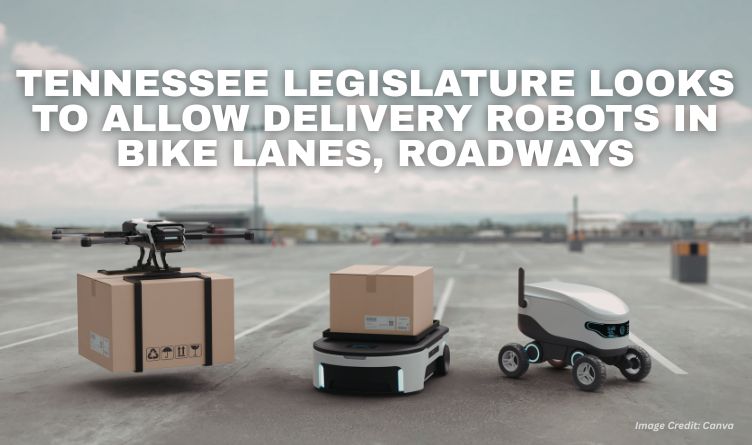
Image Credit: Canva
***Note from The Tennessee Conservative – this article posted here for informational purposes only.
This story was originally published by the Nashville Banner. Sign up for their newsletter.
by Sarah Grace Taylor, [The Nashville Banner, Creative Commons] –
The clankers are coming.
Tennessee lawmakers have advanced a DoorDash-backed bill that would set regulations for, but ultimately allow, low-speed autonomous delivery robots to travel on certain Tennessee roadways, granting them access to crosswalks and bike lanes and doubling the existing speed limit.

A bill by Sen. Becky Massey (R-Knoxville) and Rep. David Hawk (R-Greeneville) expanding the range and speed limit of autonomous delivery robots was recommended for approval in its first round of subcommittees in both chambers this week.
“It does not mandate deployment into any community, but it leverages autonomous technology for short-distance deliveries,” Massey said, adding that it could help merchants fulfill more orders.
Brent Westcott, director of policy development for delivery giant DoorDash, testified in favor of the bill during the Senate Transportation Subcommittee on Wednesday.
“To keep up with this demand, we have been developing ways to harness new technology to better serve customers and local businesses,” Westcott said.
Westcott shared a video advertising “Dot,” a 350-pound, googly-eyed delivery robot that resembles an industrialized stroller and can carry loads of up to 30 pounds at speeds of up to 20 miles per hour. The device has been handling small deliveries in Tempe and Mesa, Arizona, since the fall of 2025, but has not had any large-scale rollout.
Westcott said the use of such technology is required to keep up with demand, noting that 12,000 local Tennessee businesses are on delivery platforms, and that more than 44 million orders in 2024 were from DoorDash alone.
The bill would update Tennessee’s first crack at delivery bot legislation, a 2020 law which focused on the use of sidewalks and crosswalks, by incorporating bike lanes and some roadway use for a device like Dot, which operates at a higher speed.
By traveling on public crosswalks and bike lanes, similar delivery robots launched by other companies, such as FedEx, have caused frustration in other cities by blocking pathways relied upon by pedestrians and cyclists or causing collisions.
With sidewalk robots allowed and autonomous vehicles like Waymo already legal and operating in Nashville, Dot or its kind would not be the first robots roaming Tennessee streets, but the bill would be the first legislation to allow personal delivery robots off of sidewalks, and would double the existing delivery speed limit to 20 miles per hour.
Local governments would be allowed to ban or regulate the devices within the parameters of the state law, including limiting where in the city delivery bots may travel.
“If there’s one road that’s got way too much activity on it, they could say ‘yes, but’ — let’s just say here in Nashville — ‘not on Broadway,’ if that’s what they chose to do,” Massey explained.

During a Tuesday House Transportation Subcommittee meeting, Rep. Justin Pearson (D-Memphis) questioned the impact on gig workers and local economies if DoorDash — which reported more than $10 billion in revenue in 2024 and has been embattled with labor-related litigation, including a $16.75 million class action lawsuit in 2025 over stolen tips — is able to automate delivery jobs.
“We got a lot of people in our community that are gig workers,” Pearson said. “All the semi-automation and artificial intelligence and all that impact the economy and people’s ability to have jobs.”


One Response
What could possibly go wrong? Humans don’t need jobs.