
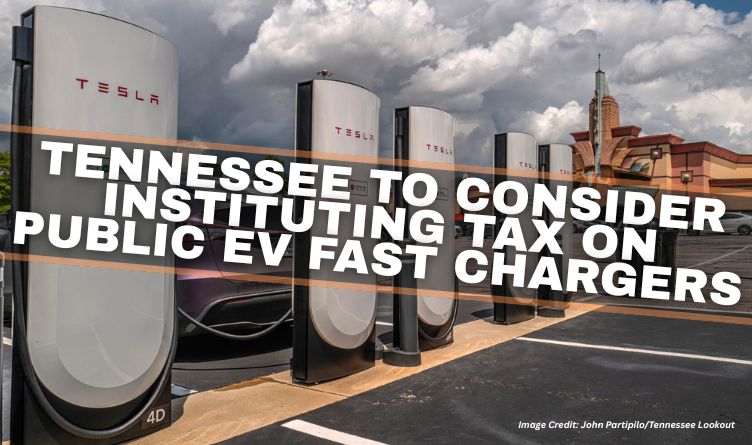
Charger operators would need to collect $0.03 per kilowatt-hour for the state.
Image Credit: John Partipilo/Tennessee Lookout
***Note from The Tennessee Conservative – this article posted here for informational purposes only.
By Cassandra Stephenson [Tennessee Lookout -CC BY-NC-ND 4.0] –
Tennessee electric vehicle owners — and those passing through the Volunteer state — could find themselves paying a little extra at public charging stations if state lawmakers approve a new bill meant to mirror a gas tax.
As introduced, the bill would institute a tax of $0.03 per kilowatt-hour on public charging stations. The tax would apply to DC fast chargers, which have a charging capacity of 20 kilowatts or more. Residential chargers and those with charging capacity of less than 20 kilowatts would be exempt.

This new tax would be in addition to annual extra vehicle registration fees that began in 2024: $200 for electric vehicle owners and $100 for hybrid and plug-in hybrid electric vehicle owners. Registration rates will rise to $274 per year for electric vehicles starting Jan. 1, 2027.
Sen. Page Walley, a Savannah Republican, introduced the bill. He said Tennessee levies a gas tax as a revenue source for maintaining roadways, and instituted the electric vehicle registration fee in 2024 to contribute to road maintenance, since electric vehicle owners do not pay gas tax.
“One of the shortcomings, though, we have discovered, is that all these tourists and folks traveling through our state who are using our roads, many of them obviously will pay the gas tax when they stop and refuel, but those that are using hybrids or EVs and are charging those at charging stations — let’s say, at Buc-ee’s or somewhere else — are not contributing anything to the maintenance of our roads,” Walley said.
But layering a new tax on top of the registration fee is punitive for EV drivers, according to Anne Blair, vice president of policy and freight at the Electrification Coalition, a nonpartisan nonprofit organization that promotes electric vehicle adoption.
“Even with just the registration fee that Tennessee EV drivers pay, that is already much more than what your typical gasoline driver pays in gas tax,” Blair said.
In Tennessee, gasoline-powered vehicle drivers pay 27.4 cents per gallon in tax. The amount of tax paid depends on a vehicle’s fuel efficiency and miles of travel, but generally ranges from $115 to $280, according to various estimates from the U.S. Department of Energy, The Sycamore Institute, and Drive Electric Tennessee.
Walley said his bill is modeled after the electric vehicle charging tax instituted in Kentucky.
A handful of states, including Kentucky, have both additional registration fees for electric vehicles and taxes on publicly available chargers. Kentucky passed legislation approving a $0.03 per kilowatt-hour tax on high-capacity charges in 2024, exempting lower-capacity chargers and free-to-use chargers at churches, libraries, parks and other places likely to have slower chargers.
Walley said he believes most EV owners in Tennessee charge their vehicles at home, or when they visit friends or family.
“But folks that are traveling through typically are going to be using, as Kentucky has found, these more publicly accessible (chargers), so that’s the logic,” he said.
The U.S. Department of Energy estimates that among EV owners, about 80% of charging happens at home.
Tennessee had 64,910 electric vehicles on the road as of September 2025, according to an Atlas Public Policy analysis of state registration data.
In Montana, which has a $0.03 per kilowatt-hour tax, an EV driver with no access to a home charger would pay an estimated $120 per year (assuming they use 4,000 kilowatt-hours of electricity and drive 12,000 miles annually), according to an Atlas Public Policy study released in September 2025. An EV driver with access to a home charger would pay closer to $24 in annual charging tax.

Electrification Coalition Policy Manager Skye Golann cautioned that a “large contingent” of people rely on public charging, including residents of multi-unit dwellings and rideshare drivers, who are disproportionately likely to drive electric vehicles due to cost savings compared to gas.
“It’s a broader group of drivers that are using those than people might think when they’re imagining just people coming through from out of state,” Golann said.
Blair said the Electrification Coalition is not completely opposed to fees for EV drivers, but “there should be some account for those EV drivers in the state that are needing to use the charger.”
Better yet, she said, the state and the nation could consider broad-scale changes to how governments pay for transportation infrastructure.
“We need funding for our roads, but we need to holistically think about what those opportunities are to change the collection mechanism that is not reliant or not tied to a fuel type … but rather the use of roads,” Blair said.


3 Responses
The coal-powered cars and charging stations were all subsidized by the federal government. They already got their corporate welfare. This bill only addresses the state funding of roadways, but the coal-powered car users are also skirting the federal fuel tax ($0.184/gallon for gas or $0.244/gallon diesel) that is used for federal highway funding. Susan Lynn’s solution for their new taxation is to buy more groceries. The more they buy, the more they save!
Good.
I’d say……no. We the people of Tennessee don’t need another tax. And NO, I don’t have an EV.