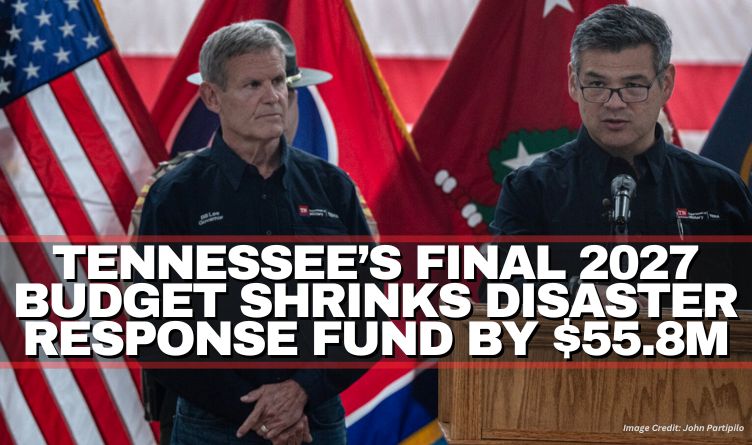
Gov. Bill Lee initially proposed putting $100M into the fund, which is meant to fill gaps in federal aid.
Image Credit: John Partipilo
***Note from The Tennessee Conservative – this article posted here for informational purposes only.***
By: Cassandra Stephenson [Tennessee Lookout -CC BY-NC-ND 4.0] –
Tennessee’s disaster response fund will receive less than half of the $100 million one-time investment proposed by Gov. Bill Lee after state lawmakers scaled back program funding in the final budget for Fiscal Year 2027.
The Governor’s Response and Recovery Fund is meant to provide assistance to local governments and individuals when aid from the Federal Emergency Management Agency falls short. This includes recovery assistance for smaller disasters that may not receive federal disaster declarations, which are necessary to tap into FEMA funds.
The fund marks Tennessee’s approach to a downsizing FEMA as President Donald Trump’s administration looks to transfer more preparedness and recovery responsibility to states.
Tennessee Sen. Majority Leader Jack Johnson, a Franklin Republican, said this year’s $58 billion budget represents a “return to a more normal economic environment.”
While Johnson praised the budget’s investment in “preparing our state for future natural disasters,” lawmakers ultimately approved a budget amendment that reduced the disaster response fund investment to $44.2 million.
“We made the responsible decision to right-size that funding after the initial allocation, while still preserving the state’s ability to meet emergency needs,” House Majority Leader William Lamberth said Wednesday in a statement to the Lookout. “The General Assembly will continue to prioritize disaster response, just as we have in the past, to ensure communities have the resources they need to recover and rebuild.”
Lamberth did not address a question regarding how the cut will impact the fund’s activities.

A representative for Lee did not respond to questions about how the reduction affects the governor’s vision for the fund. The Tennessee Emergency Management Agency, which will manage the fund, did not respond to a request for comment.
Tennessee has managed 11 disasters without federal assistance since January 2023, according to data gathered by Gov. Bill Lee’s office and TEMA. In the last 10 years, Tennessee has experienced an average of one disaster every eight months.
The expansion of the governor’s disaster fund — which was originally created in 2025 with $110 million to help communities devastated by Hurricane Helene — defines pathways for local governments and individuals throughout the state to seek assistance when federal aid is unavailable, insufficient or untimely.
Assistance through the state disaster fund could be delivered in grants, low-interest loans or no-interest loans. Funding would not be available for costs already covered by federal assistance or insurance.
FEMA assistance for local governments works on a reimbursement basis and has no set timeline, making the delivery of federal funds unpredictable. This can be especially difficult for rural communities, which tend to have smaller annual budgets.
McNairy County Mayor Larry Smith told the Lookout Wednesday that the county is still awaiting reimbursement for the millions of dollars spent on response and recovery efforts after a tornado hit the county seat, Selmer, in spring 2025. Meanwhile, the county is also facing the cost of debris removal following an ice storm that caused significant damage in January. FEMA reimbursement typically takes at least two years to come through, Smith said.
“The Governor’s disaster fund was started in response to Trump’s plan to phase out FEMA and shift financial responsibility for disasters to the states,” Sen. Jeff Yarbro, a Nashville Democrat, said in a statement to the Lookout. “It was underfunded for that purpose in the original plan at $100 million, which would basically cover one significant disaster. Cutting it by more than half shows the State can’t afford for FEMA to cut back its support, much less to stop supporting states altogether.”
“Funded at its current level, this fund can only really fill a few gaps where FEMA is too slow or too rigid,” Yarbro said.
Budget changes funded other legislative priorities, senators say
Huntingdon Republican Sen. John Stevens, vice-chair of the Senate’s finance committee, told lawmakers earlier this month that the finance committee’s budget amendment pulled from the disaster recovery fund and several other sources to support spending on healthcare reimbursement and related priorities.
Hixson Republican Sen. Bo Watson, who chairs the Senate’s finance committee, highlighted during the April 16 Senate floor session that the budget amendment allowed the legislature to allocate $25 million in recurring funding to the Commercial Airport Fund. Watson described the money as a show of the state’s commitment and a justification for state representation on airport authority boards.
The state legislature first passed a bill to take over seats on Nashville’s airport authority in 2023, sparking a lawsuit. Metro Nashville argued that the state’s move infringed on Nashville’s right under Tennessee’s constitution to have local approval of laws that specifically target a metro government. Tennessee’s Supreme Court heard arguments in that case in February.
Lawmakers this year passed a bill that will dissolve the current boards serving airports in Knoxville, Chattanooga, Nashville and Memphis. New boards will each have nine members, including six members appointed by the governor, lieutenant governor and the state House speaker. The legislation is headed to Lee’s desk for approval.
Watson also highlighted funding for expanding the cap on the state’s private-school voucher program from 20,000 students to 35,000 students. The expansion is expected to cost more than $270 million ($7,500 per child, up to 35,000 children). Any money allocated to Education Freedom Scholarships that goes unused will be put toward a savings fund for prison expansion, Watson said.
Yarbro said the Education Freedom Scholarships expansion is the “largest discretionary increase in the budget this year.”
Yarbro proposed a budget amendment that would have reduced funding for the Education Freedom Scholarship Program by $155 million, but the Senate tabled the proposal before it could go to a vote.