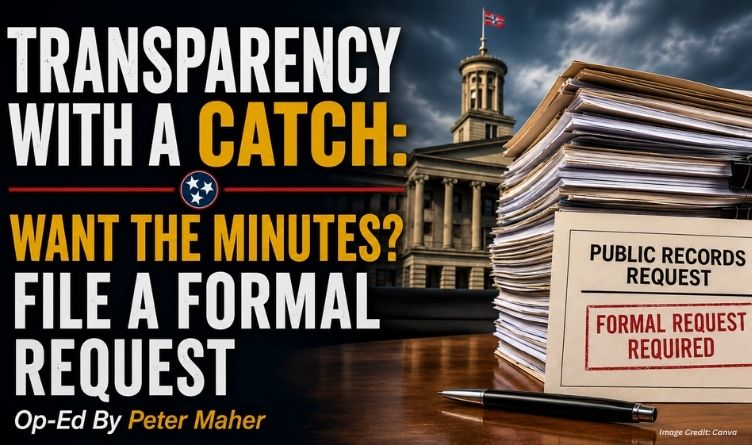
Image Credit: Canva
Note from The Tennessee Conservative: Editorial statements in this column are the sole opinion of the author; they do not necessarily reflect the opinions of the staff of this publication.
Submitted by Peter Maher –
Across Tennessee, something troubling—and increasingly common—is happening.
Our governing bodies routinely post public meeting agendas online. Tennesseans can easily see what elected officials and public boards plan to discuss. But if we want to know what actually happened—what motions were made, how members voted, what decisions were finalized—we all too often now hit a wall.
We are told to file a formal public records request.
Under current Tennessee law, public meeting minutes must be “promptly and fully recorded” and “open to public inspection.” But agendas must be posted online (if they have a website) before our public meetings (typically just 48 hours in advance).
Yet the law does not require our state’s governing bodies to post adopted minutes online. That gap has created a system where access to the official record of basic government action can depend on whether someone is willing to navigate a formal Tennessee Public Records Act (TPRA) request—often involving out of pocket financial costs, delays, or simply unanswered and unacknowledged emails.

In reality, it creates a two‑tiered system in Tennessee of elementary governance and transparency.
We are allowed to see what government plans to do—often with just 48 hours’ notice. But to see what was actually done—or how officials voted—we must file a formal request, provide our state identification, and navigate a different process set by each agency.
I’ve encountered this barrier so many times across our state that I’ve lost count. It spans institutions of all sizes and purposes: public school systems, municipalities, advisory committees, industrial development boards—and even major state agencies.
Recently, as shared here in an op‑ed, the Memphis‑Shelby County Airport Authority—which operates with a $172 million annual budget —acknowledged the issue directly.
After I raised the difficulty of accessing adopted minutes during public comment—what leadership indicated was likely the first public comment in the authority’s 57‑year history, and following the 2023 state law requiring public comment—the response was telling:
“We are planning to adopt a model similar to that of our friends over in Nashville. We like the way their website is laid out for public records and will be emulating it very soon.”
The Nashville Airport Authority, notably, already posts its adopted meeting minutes online. No formal public records request required. No delay. No barrier.
In contrast, many Tennessee governing bodies are moving in the opposite direction—toward more restriction, not less.
One Tennessee public school system recently explained its adopted minutes policy this way:
“Approved Board minutes once formally approved are maintained as official records and are made available … upon a public records request. [The public school district] does not post Board meeting minutes on its website. Therefore, if you want to review specific Board meeting minutes, you will need to submit a public records request…”
The same school district maintains a public‑facing website. It broadcasts meetings and archives them for viewing. But to access the official written record—the adopted minutes—you must initiate a formal public records process.

Even that access is not straightforward. Those archived meetings are hosted on Facebook, meaning members of the public must engage with a private platform—agreeing to its terms and data collection policies—simply to view the work of our own local government.
I’ve even found a state advisory committee that posts meetings to YouTube and votes to adopt those recordings as its official minutes—despite the videos often being grainy and hard to follow, effectively replacing a clear written record with an incomplete one.
This all raises a fundamental question:
Should access to public meeting adopted minutes depend on navigating bureaucracy—or a social media platform?
To be clear, Tennessee law requires that minutes be available. But availability is not the same as accessibility.
A Tennessee parent or teacher trying to follow school board decisions.
A Tennessee resident tracking local spending.
A Tennessee journalist working on deadline.
None of us should have to submit a formal records request to read our official record of what our local or state government has already done.
And yet, in many Tennessee communities, that is exactly the preferred system in place.
Other neighboring school systems and governing bodies demonstrate that a better approach is not only possible but already best practice. Many of Tennessee’s public school systems post agendas, minutes, and meeting materials together in one place, allowing parents, teachers, and citizens to follow both the intent and the outcome of public deliberations.
That is transparency in its true sense—not just compliance, but access.
Regrettably, when Tennessee’s governing bodies choose not to post adopted minutes, they may still meet the minimum legal requirement. But they fall short of what Tennesseans reasonably expect—and deserve.
At its core, this is not just an administrative issue. It is a question of public access, fairness, and trust.
Because when the public record of government action is technically “available” but practically hidden behind out of pocket costs, delay, or privilege, transparency becomes something that doesn’t exist.
And in Tennessee, that’s a problem our General Assembly should be fixing. Ask your local and state officials where they stand.


3 Responses
Since taxpayers fund these little get-togethers where their rights, community and plans therefor are discussed they have a right to a copy of their minutes w/o hassle. The council needs to be reminded they work for the citizens, and they are not gods or bosses, but servants. Slap down this conduct.
All that’s “of God” is open and above board.
There’s much in TN that’s NOT!
To the author > Good article. You wrote > “One Tennessee public school system…” Please list names – that gets results.