
Image Credit: Canva.
Note from The Tennessee Conservative: Editorial statements in this column are the sole opinion of the author; they do not necessarily reflect the opinions of the staff of this publication.
Submitted by Steve Abramowicz of Heartland Journal –
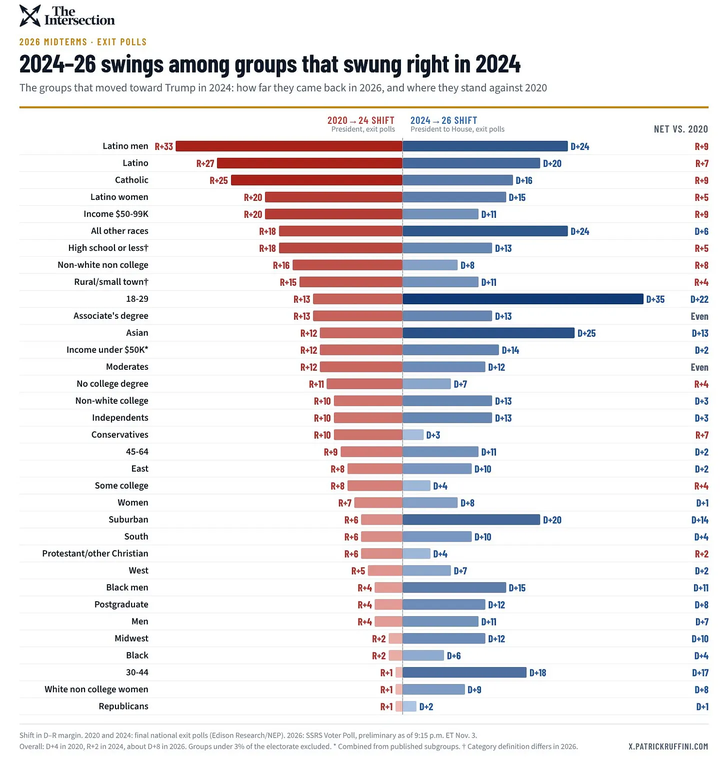
Election night 2026 delivered the South’s biggest political shock in a generation. Democrats flipped six governorships — Alaska, Georgia, Iowa, Nevada, Ohio and, most stunning of all, Texas — and sent a Democrat to the Senate from that state for the first time in roughly forty years, as James Talarico beat Ken Paxton. In Austin, the blue wave was a knockout. In Nashville, it was a near miss. The difference may come down to a single line on a fifteen-name ballot: independent David Hatley.

How Texas Went Blue
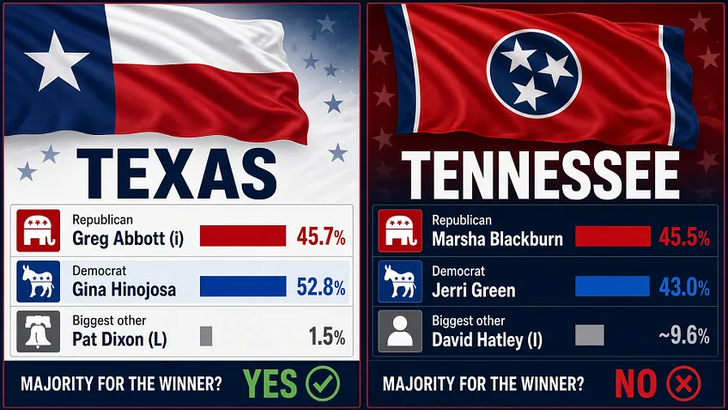
State Representative Gina Hinojosa did what no Texas Democrat has done since Ann Richards won in 1990: she unseated a sitting Republican governor, and she did it outright. With 99 percent of the expected vote counted, she led Greg Abbott 52.8 percent to 45.7 percent (5,232,690 votes to 4,525,990), with Libertarian Pat Dixon at 1.5 percent. Abbott, seeking a fourth term, conceded. Hinojosa becomes the first Latina governor in Texas history and the first Democrat to hold the office in more than three decades.
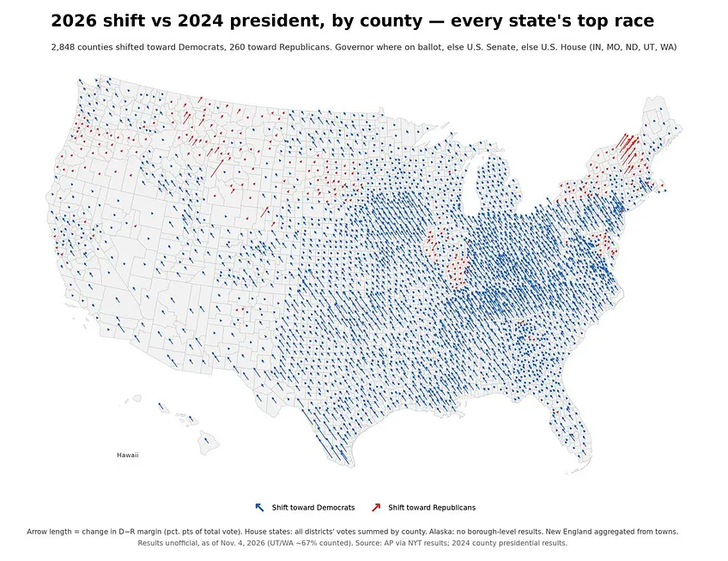
The mechanics were the mechanics of the wave itself. Every public poll heading into Election Day still showed Abbott ahead — the University of Houston’s final survey had him up three points, 49 to 46, with Dixon soaking up 2 percent. Then the undecideds broke, late-deciding voters moved together, and the anti-incumbent coalition — Democrats, independents and a slice of discontented Republicans — consolidated behind the one candidate who could actually beat Abbott. Because no third-party candidate was big enough to hold anyone hostage, the wave translated directly into votes. Dixon’s 1.5 percent was a rounding error. Hinojosa did not just win; she won an outright majority of the vote, something no Texas Democrat had managed in a governor’s race in over three decades.
How Tennessee Almost Did
Now take the same forces one state north, into what was supposed to be the safest Republican open seat in America. Bill Lee had just won re-election by 32 points in 2022, and the Cook Political Report rated this race solidly Republican. The Democratic nominee, Memphis councilwoman Jerri Green, crushed her primary with 69 percent of the vote — and was widely viewed as a sacrificial lamb.
Instead, the wave arrived. The Associated Press called the race for Senator Marsha Blackburn at 45.5 percent to Green’s 43.0 — a margin of about two and a half points in a state Donald Trump carried by thirty. Green outpolled every recent Democratic benchmark for governor, and election-night markets that had Blackburn at 94 percent spent the evening sweating.
The catch: thirteen independents were on the ballot. Nearly all of their combined 11.5 percent belonged to one man — businessman David Hatley, who finished at roughly 9.6 percent. Lauren Pinkston, the academic Green had publicly asked to withdraw, took 0.7 percent, and eleven other names split the crumbs.
The Bullet Blackburn Dodged
Consider what the polling said before the wave broke. The September TargetSmart survey put Blackburn at 45, Green at 36 — and Hatley at 10 percent, with Pinkston at 2. Hatley was not peeling support from the well known candidate; a Trump ally stuck at a 45 percent ceiling was not winning converts from a moderate businessman. Every point Hatley polled was, in practical terms, a point of the anti-Blackburn majority locked in a cul-de-sac.
Run the counterfactual. Head-to-head, Green needed to convert fewer than three points of Hatley’s 9.6 — not even a third of his coalition — to flip the election. If Hatley’s voters were, as the polling pattern suggests, chiefly a vehicle for voting against Blackburn, then a two-way ballot forces that choice to a resolution: stay home, or take the best available alternative. In a wave election, those voters overwhelmingly break away from the incumbent’s party. Add Pinkston’s 0.7 percent and the scattered residue of a dozen minor candidacies, and the arithmetic tilts decisively toward Green. Her campaign evidently believed the same math — it publicly begged Pinkston to quit the race, and by late October its polling had the gap inside two points.
Texas is the control group that proves the point. Identical forces — an incumbent Republican, a wave breaking against him, a third name on the ballot — but in Texas that third name was Pat Dixon at 1.5 percent, too small to matter, so every disaffected voter funneled to Hinojosa and the Democrat won outright. In Tennessee, the same disaffection got absorbed, dispersed across thirteen names, with Hatley functioning as a pressure-release valve. Blackburn won without cracking 47 percent. By the AP count, a majority of Tennesseans — 55 percent — voted against her, and the only thing standing between them and that outcome was a spoiling system they did not know they were using.
Two States, One Lesson
Blackburn becomes Tennessee’s first female governor, but with a two-and-a-half-point win in the state Republicans carried by 32 points just four years ago. Hinojosa won a mandate; Blackburn won a coin flip that happened to land face-up. The blue wave hit both states on November 3. In Texas, nothing stood in its way. In Tennessee, it collided with David Hatley — and ricocheted. Had the ballot carried two names instead of fifteen, those Hatley voters were quite capable of handing Jerri Green the governor’s office, and Nashville, not Austin, would have been the story of the night.


About the Author: Steven M. Abramowicz is CEO and Editor of Heartland Journal.com and host of the Heartland Journal podcast.

One Response
It’s ironic that the TN Conservative wouldn’t even interview Hatley. If it wasn’t for him, we’d have a DEM Governor. The way the paper leaned in on Blackburn from the get-go definitely has influenced our view of the paper. We are Conservative…not GOP. We, and many we know, chose to have the BEST candidate win.