Image Credit: Canva
The Tennessee Conservative [By Paula Gomes] –
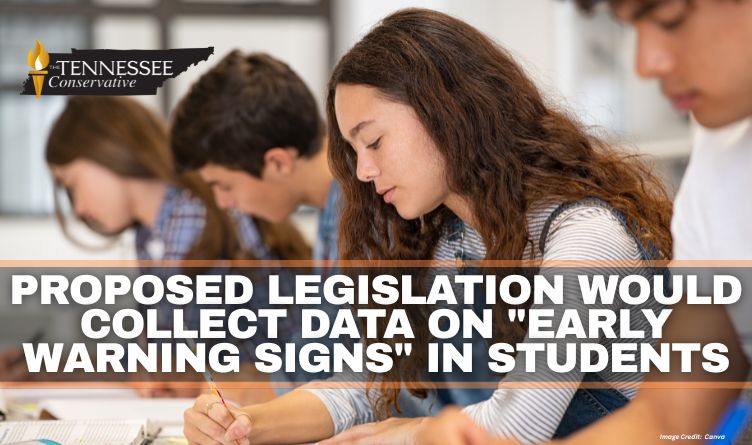
Proposed legislation would collect data on “early warning signs” in students in public school districts and charter schools.
Sponsored by Senator Bill Powers (R-Clarksville-District 22), the bill would require that teachers and staff log data in a computer system related to the behavior, health, and safety of students. “Early warning signs” needing documentation in the system include evidence of bullying, instances of self-harm or of substance abuse, and mental health issues.
Known as the “Early Behavioral Intervention and Reporting Act,” the bill would amend Title 49, Chapter 6, Part 3 of Tennessee code. Early warning signs would include, but not be limited to, “indicators of a student engaging in or being the victim of harassment, intimidation, bullying, or cyberbullying; making or receiving threats of violence; and exhibiting signs of substance abuse, mental health issues, self-harm, or suicidal ideation.”

Professional Educators of Tennessee CEO and Executive Director JC Bowman says the legislation will help kids get the support they need and help prevent tragedies.
“It’s very important that we look at how we can identify [and] help the kids get the help they need and find adults in the building – and if necessary, go outside the building and find them help – and involve the parents in the process,” said Bowman.
Every time an early warning sign is logged, staff would be required to notify the district’s Threat Assessment Team who would be charged with determining how the school should respond in addressing the situation.
Staff would be trained on to identify qualifying instances of early warning signs and the computer-based system would have to align with district policies handling harassment, intimidation, bullying and cyberbullying, as well as each school’s safety plan in accordance with the Schools Against Violence in Education (SAVE) Act.
Districts would send a report to lawmakers annually listing signs entered by staff and subsequent follow up to each incident but would not include information that identifies students.
School districts, or public charter schools, that do not comply could be denied state funds by the commissioner of education.
Details are lacking for now on whether actions taken by the school following an early warning sign will be only supportive of the student, or possibly punitive.
Last year, the vagueness in an amendment to the state’s zero-tolerance law led to a pattern of arrests of middle and high school students in Tennessee, most often with disabilities.
When we asked Bowman for his thoughts on the bill, he said, “The safety of our children and the adults in our schools must remain a top priority, and the proposed Early Behavioral Intervention and Reporting Act in Tennessee is a pivotal measure to ensure that our schools remain safe places to learn.”
Bowman also said that the bill is not just a reaction to past tragedies in Tennessee schools, but takes a proactive stance.
“It reflects a fundamental principle: while parents are crucial, our educators are responsible for students’ safety and well-being, and we must act before crises arise,” said Bowman. “In a school shooting in Antioch, Tennessee the child had brought a box cutter a few weeks prior. He was placed back in class.”
Bowman notes that disruptive student behavior directly contributes to teacher burnout as well as attrition and that both students and teachers are often the victims of assault.

According to Bowman, the proposed legislation includes several critical components that align with conservative values:
– Documentation of Behaviors: By requiring schools to log concerning behaviors, we ensure that no issue is overlooked. School administrators and guidance counselors should log the behaviors with teacher referrals. This proactive approach allows for timely interventions that can positively alter a child’s trajectory.
– Annual Reporting: Mandating that school districts submit annual reports to the Tennessee Department of Education establishes accountability and transparency. This is not just about collecting data; it’s about building trust within the community and ensuring that resources are allocated effectively.
– Threat Assessment Teams: These teams will evaluate logged behaviors, enabling tailored responses that address the unique needs of students. This targeted approach aligns with personal responsibility and the importance of individualized attention.
– Training for Staff: Equipping all school personnel with the skills to recognize early warning signs is essential. An informed staff is a powerful asset in maintaining a safe and productive learning environment.
“While the bill emphasizes the importance of data collection, it also prioritizes the privacy of students. By ensuring that no identifying information is included in reports, we maintain the trust of families and reinforce the notion that the protection of individual rights is paramount. This balance is critical for fostering a safe and supportive educational atmosphere,” said Bowman.
“As we stand at this crossroads, the Early Behavioral Intervention and Reporting Act represents an opportunity to reaffirm our commitment to the safety of our children and the integrity of our educational system,” said Bowman. “This legislation is not just a set of rules; it is a pledge to cultivate a future where every child feels secure, supported, and valued in their learning environment.”
The proposed legislation does not yet have a House sponsor.
Tennessee lawmakers will reconvene in Nashville for the 2026 legislative session on January 13th.

About the Author: Paula Gomes is a Tennessee resident and reporter for The Tennessee Conservative. You can reach Paula at paula@tennesseeconservativenews.com.

2 Responses
Sounds good but don’t expect much from lucifer’s accursed dimmercrap “teachers”.
This sounds TERRIBLE. School personnel do not have the expertise to start labeling behavior. This is the start to control over children and parents better wake up. This does NOT belong in any school. It does NOT sound good; schools are not in the business of raising children, they are suppose to be teaching. Not judging. Teachers are not equipped in any way to do this, and God forbid the administration. Parents beware!!