
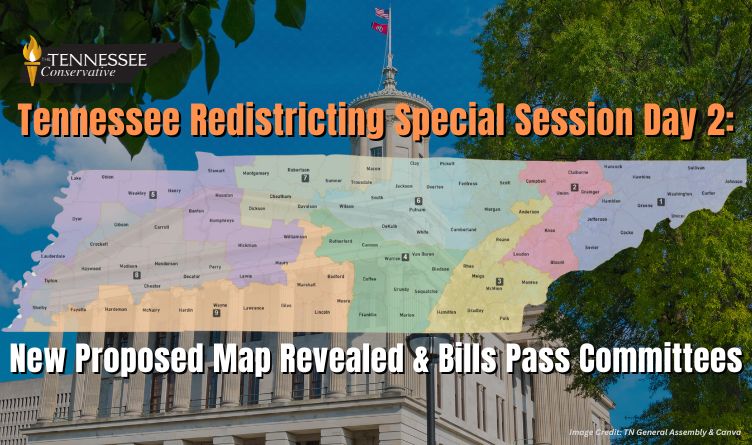
Image Credit: TN General Assembly & Canva
The Tennessee Conservative [By Olivia Lupia] –
Day two of the special session to redraw Tennessee’s congressional map moved relatively quickly as lawmakers revealed the new proposed map and considered several bills in anticipation of final floor votes on Thursday as Democrats continued their objections and protests. (See the bill explanations below for a photo of the map)
Both chambers had brief morning floor sessions which saw House Democrats clogging up the floor proceedings with several parliamentary and procedural inquires while Senator Charlane Oliver read into the record a lengthy statement on the Memphis Massacre of 1886.
The real work of the day was done in the appointed House and Senate committees where members discussed six bills. Democrats recycled their talking points and hot button phrases, including “racial bias” and “voter confusion”, all through the day, with some House and Senate members asking the exact same leading questions during committee meetings.
Here’s an updated look at the bills committees voted on Wednesday, May 6, all of which passed along party lines unless otherwise indicated:
HB7002/SB7002– Deletes statutory language limiting congressional redistricting to after the decennial census
This bill was heard first by both the Senate State and Local Government and House Redistricting Committees as it creates the statutory permissions for lawmakers to reexamine or change the congressional map.
The Senate heard testimony against the bill from Dr. Sekou Franklin, Political Science Professor at MTSU and Political Action Chair for the Tennessee State Conference of the NAACP. He said the redistricting is “racially discriminatory”, “unconstitutional”, will cause “havoc” and “chaos” in the election system, and “silences the Black voters of Memphis.”
Similar arguments were heard from Democrats in the House, citing “voter confusion” and “racial bias” and objecting to the compressed timeline of redistricting so close to an election. Rep. William Lamberth stated that as there are still more than 90 days between now and the August primary, he believes there is ample time for local election administrators to rework ballots, get voting machines prepared properly, or execute any other functions which would be required by the redistricting taking effect.
Dr. Franklin also testified in House committee against the bill alongside attorney Walter Bailey, who once worked with Martin Luther King Jr., and Congressman Steve Cohen, the current Representative for District 9. Cohen called the redistricting effort a “disparagement of African American voters,” and claimed to “have a Black perspective on politics and the need to make Tennessee a better state by reaching back and redressing grievances from when we had slavery in our state and we had Jim Crow laws in our state.”

HB7001/SB7001– Revises candidate qualifications & requirements for the 2026 congressional election
Also heard in the Senate State and Local Government Committee, the amended version of this bill “establishes a temporary framework for administering the ’26 congressional elections if the district boundaries are revised,” according to Sen. Adam Lowe.
SB7001 will allow already qualified candidates to remain on the ballot for the district in which they originally qualified, allow them to transfer to a different district, or withdraw from the contest. It also creates a special qualifying period for any additional candidates in the new districts with a qualifying deadline of noon on May 15, 2026.
The bill requires public notice of the revised boundaries, qualifies procedures and candidate information through the Secretary of State and county election commission websites, and provides county election commissions with additional state resources and reimbursement processes for the unbudgeted costs associated with updating voter assignments, ballots, and other necessary changes.
Finally, legal challenges to the revised districts will be heard by a 3-judge panel, consistent with existing law, and will only apply to 2026 congressional elections, being automatically repealed at the end of year.
Natalie Tennant, the former West Virginia Secretary of State, spoke against the bill at the request of the Democratic Caucus. “It sounds like you don’t care what election administrators are going through, voter confusion, or damaging public trust,” she said.
Before the vote could be taken, the audience erupted into chants of, “Hands off our votes,” prompting Chairman Richard Briggs to call for a recess and law enforcement to clear the room. The committee resumed discussion in a different hearing room which was closed to the public, to which Democrats objected.
In the House Redistricting Committee Rep. Jason Zachary immediately called the question on the bill, preempting any debate as the audience loudly sang the National Anthem to drown out proceedings.
HB7003/SB7004 – New proposed district lines
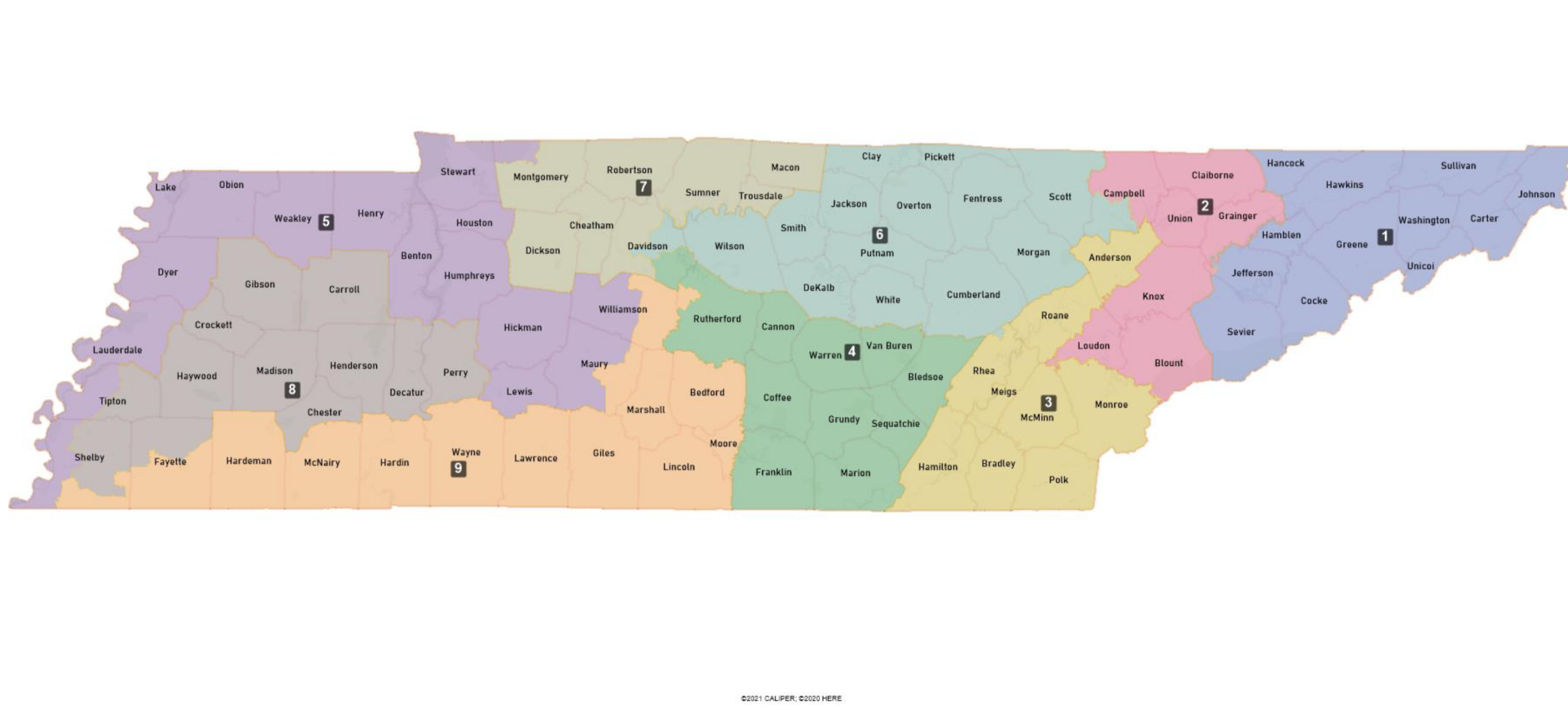
Democrats continued with their same arguments, objections, and questions as the previous bills, and the Senate Judiciary committee heard from three witnesses against this bill which actually creates the new proposed district boundaries.
Attorney Walter Bailey testified again, saying the redistricting is “racial fragmentation” and a “subliminal euphemism for racism” and will dilute Shelby County votes to the point where they lose power as a voting bloc.
The second witness was Stacey Abrams, prior member of the Georgia General Assembly and failed Democrat gubernatorial candidate. She emphasized “voter confusion” and said the “compressed timeline [of the redistricting] signals there is not a good faith intention behind it. At a time when communities of color are already under siege, Memphis is being told ‘We will deny you even one voice in Congress’… I think it is an act of cowardice to deny them that voice.”
Congressman Cohen reused much of the same verbiage as his testimony in the House Redistricting Committee, but also said, “African Americans are my priority, even though I’m white”. There was some banging on the doors from protestors watching the hearing in the hallway, and Cohen said it reminded him of being in Washington during the January 6 “insurrection”. “I heard that knocking on the doors. And it shouldn’t happen here, but you’re causing it,” he accused.
The House, again, heard the exact same arguments, questions, and data points employed by Democrats all day, and the audience overpowered the committee, chanting after a Republican member made a statement they didn’t like. Chairman Andrew Farmer ordered the room to be cleared but the crowd refused to leave.
Farmer tried to continue with business instead of waiting for law enforcement to remove the audience, and a vote on another bill was taken though Democrat members said they could not understand the proceedings over all the noise and didn’t know on what they were voting.
HB7005/SB70005 – Appropriates $3,154,700 for the cost of the special session and implementation of the redistricting
The appropriations measure allows the state to use existing funds to pay for the expense of the special session, including per diem for members and administrative costs, and provides funding for covering the costs to state election officials and county election administrators for implementing the revised congressional districts in time for the 2026 election cycle.
In the Senate Finance, Ways, and Means Committee there were only a couple clarifying questions before the committee moved to the vote and Chairman Bo Watson stated the anticipated cost for the special session is approximately $140,000.
House Democrats said they don’t believe the roughly $3 million will be enough to reimburse the expenses incurred by the counties to make the necessary adjustments, but Rep. Ryan Williams asserted several times he was confident the amount would be more than enough to ensure locals don’t bear the cost burden for the implementation. He also said the state is anticipating 42 of 95 counties being impacted with the new maps.
HB7006/SB7006– Democrat redistricting proposal, similar to 2020 map
This proposal failed in both the Senate and House committees along party lines.
SB7003/HB7004– Backup bill in case SB7002 did not pass, sent to General Sub
Additional Bills:
The House Redistricting Committee also heard two resolutions, one Republican and one Democrat, proposing a constitutional amendment which would ensure future redistricting efforts would only be permitted following the decennial census.
HJR7006 by Republican Jody Barrett was intended to rectify, “one of the primary issues we’re hearing from both our voters and constituents back home but even here amongst the body, that there’s a bipartisan concern about doing this in between a census.”
“We’re doing this now to correct an issue that has been identified by the Supreme Court case, and I think the Speaker has done a good job of explaining what criteria has been used to draw the map that we’re currently considering, but this would make it such that in the future, if we were to amend the constitution to limit any changes to the congressional maps to in between censuses, that would take one of the arguments off the map, and I think there is bipartisan support for that,” Barret said.
However, as the Senate chose not to allow the resolution on their calendar, it will not proceed and was taken off notice.
HJR7009 by Democrat Jason Powell offered a similar proposal to Barrett’s, albeit with far more liberal perspective and verbiage, and was sent to the first calendar of 2027, essentially killing it.
The bills passed by the committees will be heard on the House and Senate floors today, which may be the end of the Second Extraordinary Session of the 114th General Assembly, though lawsuits are likely to be filed immediately upon its conclusion if the redistricting measures pass.


About the Author: Olivia Lupia is a political refugee from Colorado who now calls Tennessee home. A proud follower of Christ, she views all political happenings through a Biblical lens and aims to utilize her knowledge and experience to educate and equip others. Olivia is an outspoken conservative who has run for local office, managed campaigns, and been highly involved with state & local GOPs, state legislatures, and other grassroots organizations and movements. Olivia can be reached at olivia@tennesseeconservativenews.com.

3 Responses
Republican political leaders in our state may be getting this one right….I say, frankly….it’s just time our GOP proves that they’ve grown a spine. But, one would think that if they were THIS motivated to wipe out Democrat leaning congressional districts, that they would NOT have been so hypocritical as to KILL the PRIVATE PRIMARY BILLS in the state legislature this last session…This alone proves they are up there for their own political careers. We have way to many RINOs who depend on ‘cross-over’ Democrat votes, that should be illegal. Remember, one does not have a ‘right’ to vote in a private primary, but thousands of Democrats LIE and cross over to vote in a Republican Primary, of course voting for the least conservative Republican, because our state does not have the political will to enforce the law, but not out of principle, out of the fact that they actually BENEFIT from the cross over votes! Our state political leaders are willing to be hypocritical and shameless to advance their own political aspirations and they are only willing to take a stand when it is convenient!
Dist. 5 is ridiculous, Memphis should only be 2 districts.
Just looking at the district outlines I think the Legislature should take another look. Some of the districts make no sense geographically. IMHO the districts should reflect the population that lives in a compact (close) area. For example: Districts 2 and 3 stretch along an area side by side rather than more “square”. What would happen to the population makeup if Loudon and Blount (in District 2) where switched with Anderson and Roane (District 3). It would appear to be more compact. Districts 5, 8 and 9 are even MORE ridiculous! Stop playing POLITICS with residents to maintain your elected positions! Districts should never be made up for racial, religious, ethnic or political party reasons. Why can’t we just TRY to be fair to ALL TN residents? I am a conservative who believes we should play fair and let the chips fall where they may. I believe if you have the correct ideas, people will vote for you. You don’t have to try rig the elections to stay in power.