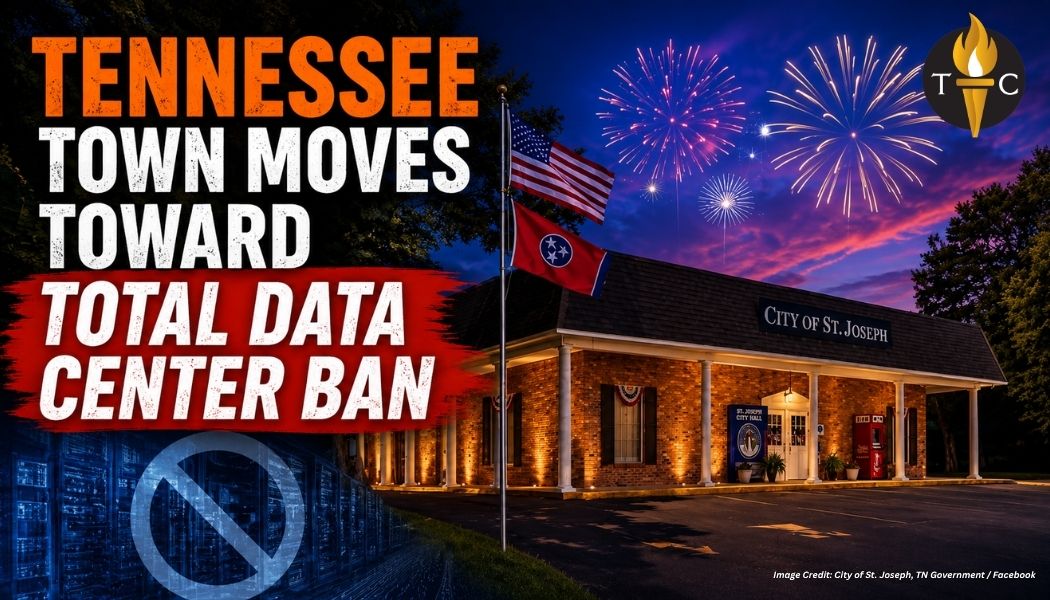
Image Credit: City of St. Joseph, TN Government / Facebook
Tennessee Conservative News [By Olivia Lupia] –
St. Joseph, a rural town in Lawrence County with a population of less than 1,000 residents, is on track to pass a total ban on data centers after the Board of Commissioners voted last week to pass an ordinance prohibiting any attempts at creating data centers in the area.
Ordinance No. 2026-0707 essentially bans “data centers, artificial intelligence computing facilities, cryptocurrency mining operations, and similar high-intensity digital infrastructure throughout the city limits.” It also prohibits all permits, approvals, utility extensions, or other authorizations for a future facility.

The language includes protections against any “work-around” to develop any commercial or industrial-scale data centers, including preventing projects from being divided, renamed, phased, or structured in any way that attempts to subvert the ban.
According to the city’s press release, the Board’s action on the ordinance “follows credible information that multiple data center projects are being discussed in parts of Lawrence County, including one rumored in southern Lawrence County. While the potential project in southern Lawrence County is outside St. Joseph’s corporate limits, city leaders said St. Joseph is acting now, before any application is filed inside the city, to protect its water, roads, utilities, public safety resources, and rural way of life.”
City officials said the ordinance is about maintaining local control and ensuring St. Joseph decides what “fits” in the city, “not developers or corporate interests”.
Mayor William R. “Bubba” Carter stated the ordinance reflects the city’s responsibility to put St. John’s residents first and protect the community’s future.
“One of the main pillars of Operation First Impression is putting citizens first and protecting their interests,” Carter said. “This ordinance falls directly in line with that mission. St. Joseph’s resources should serve the people who live here, and we have a duty to protect our water, our community, and our future.”
Vice Mayor Beverly White added the measure will help protect essential services from “unnecessary strain.”
“Our systems were built for a small community, not massive industrial computing operations,” White said. “We cannot allow a project like this to put pressure on the water, roads, utilities, farms, and emergency services our residents depend on every day.”

And Commissioner Marty Passarella and City Manager Chris Jackson noted the ordinance is a prevention mechanism, keeping the city from being forced to react down the line.
“We are taking a stand now because waiting until later is how small towns get pushed around. The people of St. Joseph expect us to protect this community, and that is exactly what this ordinance is designed to do,” Passarella said.
“We are not going to let outside interests decide the future of St. Joseph,” Jackson said. “Our water is limited. Our infrastructure is limited. Our way of life matters. We may be small, but we are not powerless. Hopefully, St. Joseph can show other rural communities how to stand up to big-money interests looking to take advantage of them.”
With the first approval by the Commission, the St. Joseph ordinance will be reviewed by the city’s planning commission and heard at a public hearing where all residents and property owners will have the chance to be heard before going back to the Board for a second final reading and vote.
Should the St. Joseph ordinance pass, it would be among the first in Tennessee to formally prohibit data centers through local ordinance.
Several other cities and counties are working through their own regulations, hoping to possibly implement full bans themselves down the line, but have settled for temporary moratoriums in the meantime as they keep an eye on legal challenges to other cities outside Tennessee who have attempted to impose outright bans.
Meanwhile, residents of another Lawrence County city, Lawrenceburg, are in the midst of their own battle against data centers, with over 7,300 of the city’s 14,000 residents signing a petition asking the city to implement an 18-month data center moratorium. But the Planning Commission unanimously voted to approve plans for a data processing center, and the proposal now heads to the city council where it is likely community pushback will continue.


About the Author: Olivia Lupia is a political refugee from Colorado who now calls Tennessee home. A proud follower of Christ, she views all political happenings through a Biblical lens and aims to utilize her knowledge and experience to educate and equip others. Olivia is an outspoken conservative who has run for local office, managed campaigns, and been highly involved with state & local GOPs, state legislatures, and other grassroots organizations and movements. Olivia can be reached at olivia@tennesseeconservativenews.com.

3 Responses
Gee we don’t know how to deal with anything beyond sweet talking people into voting for a dumb mayor and/or council……give us the simple things….nothing hard….nothing we have to use our brains…. who do you think we are anyway?? some kinda public servant or slave?? we don’t want to do hard work…we don’t know what to do……..leave us alone,
Yeah…. I might have over played the comment but I’m not that far off I bet.
What every county/city should do. The things are a detriment to everyone except their builders/owners.
“The things are a detriment to everyone except their builders/owners”. Can you explain your position of do nothing because that sentence makes no sense at all. Or… explain how they stay in business if they are “a detriment to everyone”. A single AI data center delivers 100 megawatts of continuous AI compute power….. Revenue per year ≈ 100 MW × $12.50/W × 8,760 hours/year ≈ $1.1 trillion/year. This is a 26× higher annualized revenue than a traditional center of similar size. A single AI data center of 100 MW capacity could generate tens of trillions of dollars in lifetime revenue when scaled across the global AI boom, assuming sustained high demand and efficient operations. The sector’s growth trajectory and efficiency gains make AI data centers one of the most lucrative infrastructure investments of the decade. The intellectual firepower you display here is truly impressive. Instead of trying to figure out how to negotiate good deals, requiring proper infrastructure, realistic water & power usage, and actual tax revenue. Your brilliant solution is “just ban them and hope it all works out because you don’t understand AI”. Nothing says strong intelligent leadership like “we don’t know what to do, so let’s not deal with it and say we’ll study it for a year while the good opportunities go somewhere else.” Data centers aren’t going away. The smart localities are learning how to manage them and extract real benefits. The lazy low IQ ones just throw tantrums and moratoriums. Hope they can find a brilliant solution when their electric bills go up and their tax base stays flat. I doubt it…………