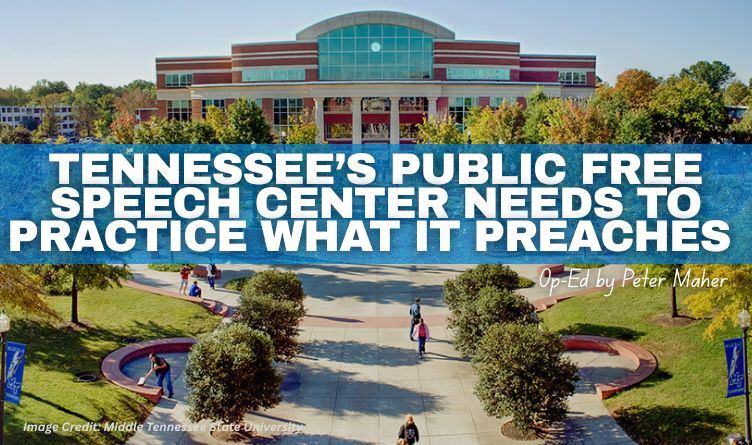
Image Credit: Middle Tennessee State University
Submitted by Peter Maher –
Our Free Speech Center at Middle Tennessee State University was created and intended to champion the First Amendment. Its mission is laudable: educate students, inform the public, and defend the principles of free expression. But when a taxpayer-supported program operates behind closed doors, restricts public engagement, and partners with opaque organizations, it risks undermining the very values it was entrusted to uphold.
In an early 2025 email response to a citizen’s inquiry, our Free Speech Center at Middle Tennessee State University volunteered that it is “a small educational institution with a focus on teaching high school students” and that “our online content, including analytical columns, comes from the Associated Press.” The email from Middle Tennessee State University also stated that the taxpayer-funded center has no public meetings, advisory boards, and does not consider nor publish guest columns from everyday Tennesseans, only “educators, scholars, and experienced journalists.”.

First, governance. The Free Speech Center confirms it has no advisory board, no public meetings, and no posted bylaws. It functions within MTSU’s structure yet offers no center-level charter or accountability framework. This lack of transparency is compounded by its partnership with the John Seigenthaler Chair of Excellence, directed by a registered lobbyist employed by the Tennessee Coalition on Open Government—a nonprofit whose own Form 990 filings omit donor names. When public dollars intersect with undisclosed private influence, the public deserves answers.
Second, budget opacity. Annual reports highlight activities but omit line-item details. Gifts appear to flow through the MTSU Foundation, which aggregates financials without breaking out spending for the Free Speech Center. Taxpayers cannot see how much is spent on Associated Press content, staff salaries, outreach campaigns, or our high schooler-focused materials. The Tennessee Public Records Act requires disclosure, yet proactive transparency is absent.
Third, public engagement. The irony is concerning: a center devoted to free speech that forbids reader comments and guest submissions. Instead, it republishes Associated Press stories—paid for with public funds—without offering citizens a voice. Free speech education should model civic dialogue, not restrict it.
Fourth, K–12 outreach. The public Free Speech Center provides classroom resources and an educator e-book aimed at high schools. But it does not publish review protocols or age-appropriateness guidelines, even for controversial encyclopedia entries like Alvin Goldstein, a pornographer and First Amendment litigant, and the First Amendment Lawyers Association, which has historically defended the adult entertainment industry. Both normalize pornography as protected speech—a legitimate debate for adults, but not appropriate for Tennessee’s public high school classrooms. All Tennesseans deserve clarity on how materials are vetted.
Finally, partnerships and lobbying. The taxpayer-funded Seigenthaler Chair of Excellence in First Amendment Studies raises additional questions about influence on content and priorities. The public chair was instituted in 1986 to honor John Seigenthaler, the longtime editor and publisher of The Tennessean in Nashville. Combined with apparent donor secrecy at affiliated nonprofits employing registered lobbyists, this creates a troubling lack of accountability and contradicts the very spirit of our First Amendment. Taxpayer-funded programs should not operate in a gray zone where advocacy networks and undisclosed donors shape public educational initiatives.
The solutions are straightforward. Publish Bylaws and governance structures, if they exist. Disclose budgets and donor lists. Post editorial policies and comment guidelines. Welcome and invite public participation and engagement through online comments and governance meetings. Provide transparency on curriculum review and age-appropriate standards. Require staff to hold and disclose their Tennessee Department of Education licensure for any instruction involving Tennessee’s high schoolers. Require donor and lobbying disclosure for all nonprofits partnering with these state-funded programs.
Tennessee’s public Free Speech Center was intended to defend openness and dialogue. It should lead by example. In an era when trust in our state’s public higher education institutions is fragile, transparency is not optional—it is the foundation of credibility. All Tennesseans—especially our educators and students—deserve nothing less.


2 Responses
Whatever lucifer’s accursed dimmercraps are involved with is gonna be trash.
“…………………only “educators, scholars, and experienced journalists.” Mmmmmuuunnnbbblleee (not allowed to post a comment) mmmmuuummmmbblleee.