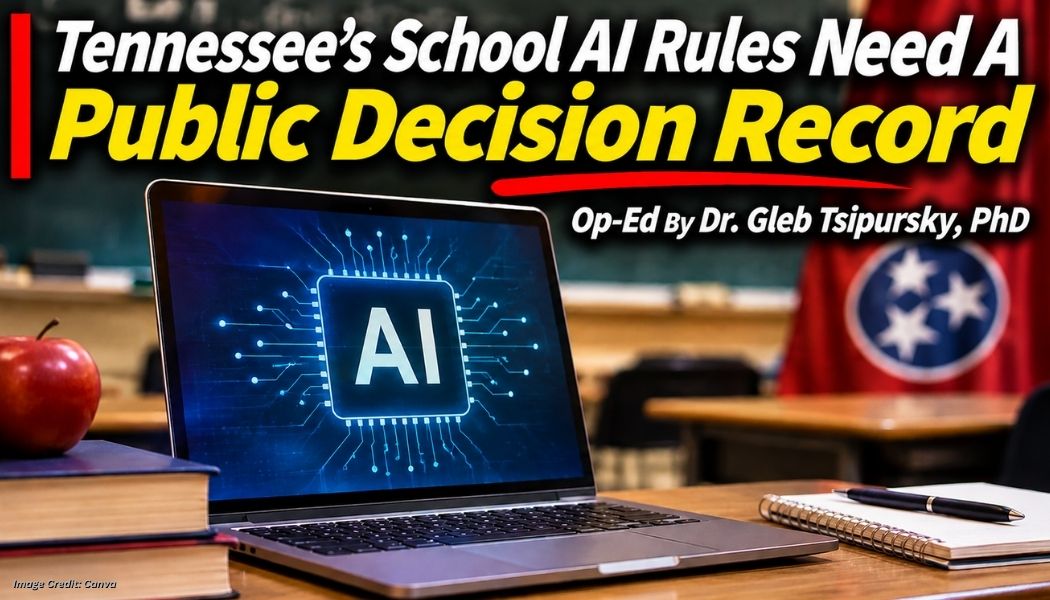
Image Credit: Canva.
Note from The Tennessee Conservative: Editorial statements in this column are the sole opinion of the author; they do not necessarily reflect the opinions of the staff of this publication.
Submitted by Dr. Gleb Tsipursky, PhD –
Tennessee families should not have to guess who decided which artificial intelligence tools children can use in school, what those tools do with student information, or which classroom activities still require independent work.

The debate has already reached state government.
An October report by The Tennessee Conservative described a lawsuit alleging that an education subcommittee involved in developing AI policy met improperly behind closed doors. The allegation deserves to be assessed on the evidence, without treating the complaint itself as proof of a violation. But Tennessee does not need a court finding to understand the broader problem: parents and teachers need a way to see how these decisions are made.
The need for clarity became more urgent on November 3, when Google announced new AI education features and administrative controls. Schools using its products now face choices affecting search, AI assistance, and student learning. Different districts may make different reasonable decisions. What matters is that the decision belongs to accountable educators and public officials, with families informed.
I recommend that Tennessee establish a short, public AI decision record for every school system. It should answer five questions in ordinary English.
Which tool was approved? ‘Artificial intelligence’ is too broad a category. A spelling aid, a research assistant, and a system that creates entire answers call for different rules. Name the product, intended student age group, and specific classroom uses.
Who authorized it? Identify the board policy or administrator responsible for approval. The person should also have authority to suspend a tool when serious problems emerge. If a vendor changes capabilities or data practices, require a new review rather than assuming yesterday’s permission covers tomorrow’s product.
What information can it receive? Families deserve to know whether students may enter personal details, whether teachers may upload graded work, and what information is prohibited. A privacy promise is meaningful only when schools explain how staff and students will follow it.
What must students do themselves? Assignments should identify whether AI can brainstorm, correct grammar, or help find sources, and which reasoning, writing, and calculations learners must demonstrate independently. Teachers need room to distinguish practice from graded proof of understanding. Students also need examples, not vague warnings about ‘responsible use.’
How will anyone know the policy works? Track disputed answers, student understanding, teacher correction time, privacy incidents, and parent concerns. Publish an accessible summary on a regular schedule. The number of accounts activated tells parents little about whether learning improved.
The psychology of adoption matters here. When schools hand teachers an unfamiliar tool without clear expectations, some avoid it while others improvise. Students then receive conflicting rules from one classroom to another. When leaders offer training, consistent boundaries, and a safe way to report mistakes, people have a better chance of using the tool competently.
None of these safeguards assumes that every educational AI system is harmful. Some may help a teacher adapt reading material or give a student extra opportunities to practice. Those potential benefits are worth testing against actual student learning. They are poor reasons to keep the rules obscure.
Tennessee can publish policy drafts, invite practical questions from parents and teachers, record decisions, and revisit them when products change. That would give local school boards room to make choices while making those choices visible.
A family should be able to find one page that says what a school approved, why, who is responsible, and how to challenge a mistake. That is a reasonable standard for any technology entrusted with a child’s education.

About the Author: Gleb Tsipursky, PhD, a behavioral scientist, CEO of Disaster Avoidance Experts, and author of The Psychology of AI Adoption at Work: From Resistance to Results (Georgetown University Press, 2026). https://disasteravoidanceexperts.com/aibook