
Image Credit: Canva
The Tennessee Conservative [By David Seal] –
For decades, school boards, their attorneys, and many others have been confused about the legality of having an opening prayer at school board meetings. Tennessee legislators and the governor put an end to the confusion with the passage of HB1834 / SB1957.
Tennessee Code Annotated § 49-2-203(b) prescribes the 16 powers of Tennessee school boards. The enacted bill adds the 17th power, which states in part: “(b) The local board of education has the power to: (17) Open a meeting of the board of education with a prayer led by a member of the board of education; provided, that: (A) The prayer does not require participation of any person in attendance at the meeting; and (B) No person is harassed or coerced to participate in the prayer.”
The argument and confusion over prayer at school board meetings has been generated by a radical interpretation of the First Amendment by church and state separationists, despite a flood of recent court opinions and laws created by various states supporting the free expression of religion in public settings.
Opponents of prayer in public meetings have been at it for a long time attempting to stamp out any trace of religious expression. Many of the nay-sayers focus on school board meetings fearful that students will hear a prayer being recited or that they could fall victim to religious indoctrination.
Those arguments fall apart when meetings of state legislatures, county commissions, and court proceedings are opened with prayer, many of which have students and children in attendance.

Despite the high court opinions supporting religious expression, bills H 1834 by Representative Rick Eldridge (R-Morristown) and SB1957 by Senator Mark Pody (R-Lebanon) were necessary to clarify policy and to empower school boards in Tennessee to open their meetings with prayer.
The preamble to the bill references the Free Exercise Clause of the First Amendment and states that school board members are not excluded from it. HB1834 / SB1957 also states that the Tennessee General Assembly takes a firm position on religious freedom by codifying the right of local board of education members to exercise their religious beliefs by reciting a non-coercive personal prayer to open a school board meeting.
Many school boards, school directors, and their attorneys that are hostile to prayer at board meetings rely on an outdated and overturned case from the U.S. 6th Circuit Court of Appeals, Coles v. Cleveland Bd. of Educ., 171 F.3d 369 (6th Cir. 1999).
Coles relied explicitly on a decades-old supreme court opinion, Lemon v. Kurtzman, 403 U.S. 602 (1971). Lemon created a complex three prong test for determining violations of the Establishment Clause of the First Amendment. Kennedy v. Bremerton School District, 597 U.S. 507 (2022) overturned the Lemon decision by requiring courts to evaluate establishment clause violations based on the “history and traditions” of the country rather than the test established decades earlier by Lemon.
Additionally, Marsh v. Chambers, 463 U.S. 783 (1983) determined that opening prayers for legislative and other deliberative bodies were not a violation of the Establishment Clause of the First Amendment.
The issue of coercion is often cited by opponents of prayer in public meetings. The U.S. Supreme Court put this issue to rest in Town of Greece v. Galloway, 572 U.S. 565 (2014). A majority of the Supreme Court held that sectarian prayers at legislative meetings are permissible under the United States Constitution, stating, “Legislative bodies do not engage in impermissible coercion merely by exposing constituents to prayer they would rather not hear and in which they need not participate.”
HB1834 / SB1957 prohibits coercion or harassment of any person in attendance at a school board meeting.
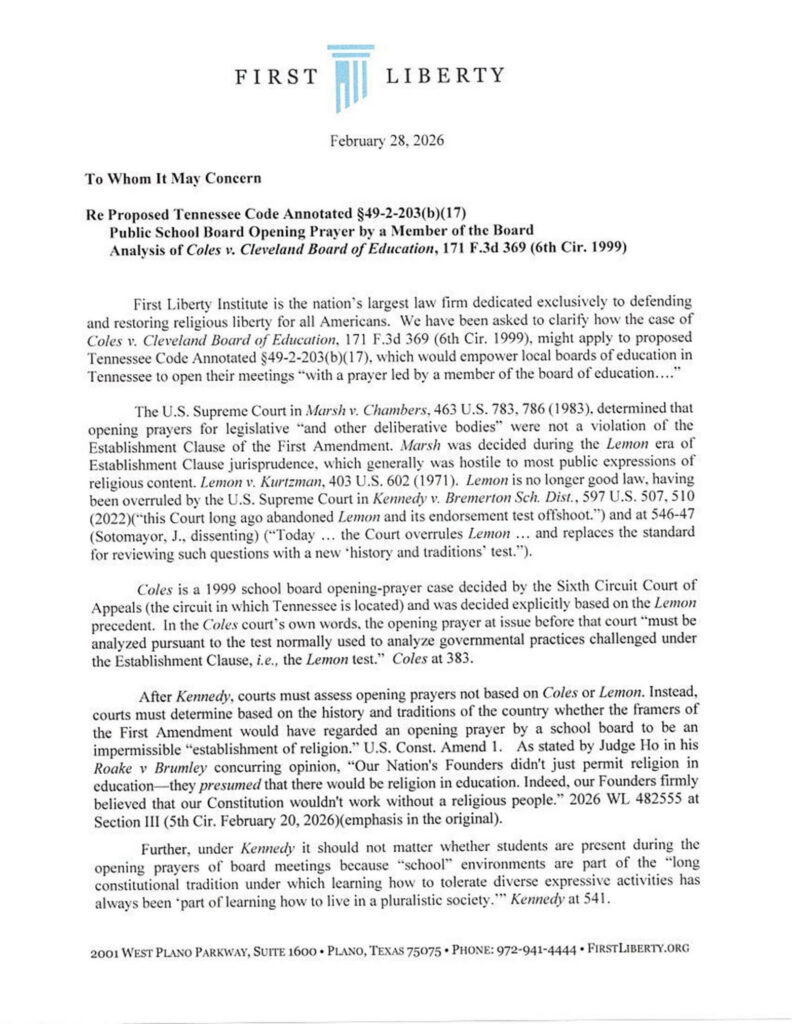
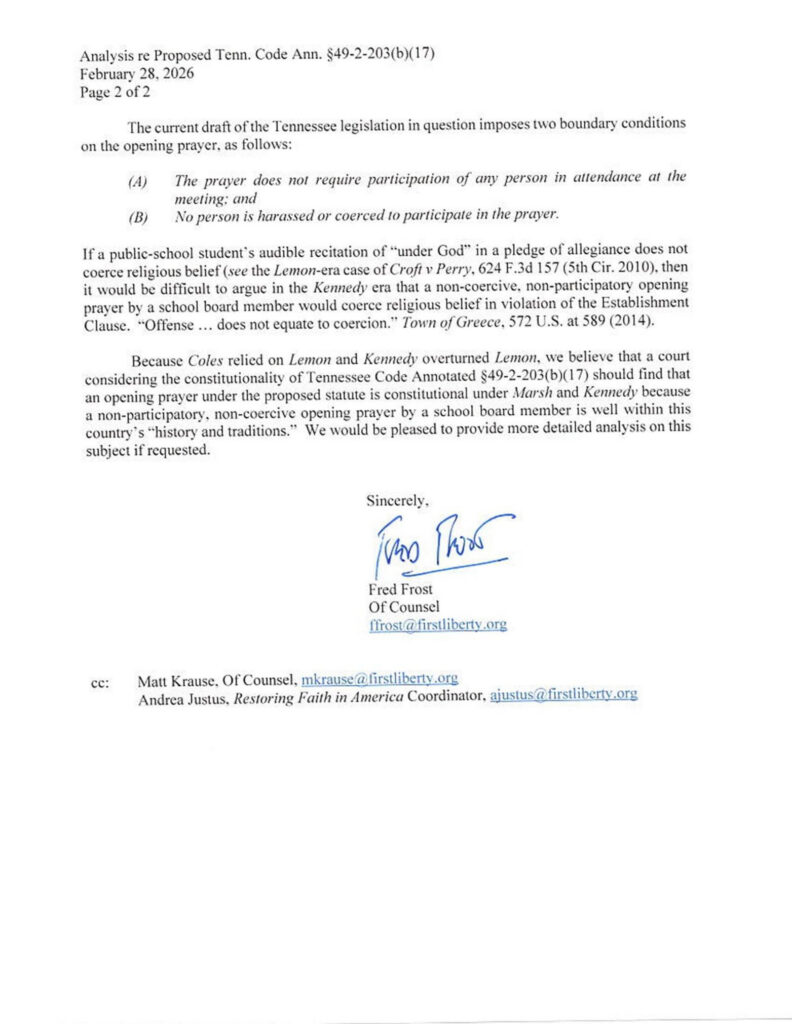
For a legal analysis of HB1834 / SB1957, T.C.A § 49-2-203(b)17 and its constitutionality relative to multiple cited cases, a memorandum from First Liberty Institute is provided below.
Nathan v. Alamo Heights ISD, No. 25-50695 (5th Cir. 2026), decided by the U.S. 5th Circuit Court of Appeals provides an even stronger path to religious freedom in upholding a Texas Law (SB10) that requires public schools to display the Ten Commandments. The court opined, in part, as follows with an even stronger abandonment of Lemon v. Kurtzman, 403 U.S. 602 (1971) and Stone v. Graham, 449 U.S. 39 (1980).
“We conclude the Texas law does not violate either the Establishment Clause or the Free Exercise Clause. Here is a summary of our reasons. First, the Establishment Clause. Plaintiffs primarily claim we are bound by Stone v. Graham, 449 U.S. 39 (1980) (per curiam), which invalidated a similar Kentucky law decades ago. We disagree. Stone applied an analysis—the “Lemon test”—which confounded courts for decades. See Lemon v. Kurtzman, 403 U.S. 602 (1971). Mercifully, the Supreme Court jettisoned Lemon and its offspring some years ago. See Kennedy v. Bremerton Sch. Dist., 597 U.S. 507, 534 (2022) (recognizing the Court has “abandoned Lemon”). With Lemon extracted, there is nothing left of Stone.”
A link to Nathan is provided here. TX-Ten-Commandments-opinion.pdf
With Coles v. Cleveland Bd. of Educ., 171 F.3d 369 (6th Cir. 1999) in the ashbin of history, and HB 1834 / SB 1957 signed into law by Governor Bill Lee, opponents of prayer at school board meetings will now have precious little to hang their hat on.


About the Author: David Seal is a retired Jefferson County educator, recognized artist, local businessman, 917 Society Volunteer, and past Chairman of the Jefferson County Republican Party. He has also served Jefferson County as a County Commissioner and is a citizen lobbyist for the people on issues such as eminent domain, property rights, education, and broadband accessibility on the state level. David is also a 2024 winner of The Tennessee Conservative Flame Award & has received an accolade from the Institute For Justice for successfully lobbing the TN legislature to protect property rights. David can be reached at david@tennesseeconservativenews.com.

One Response
Good, thanx! Lucifer’s accursed dimmercraps hate God and His.